| ⇦ | 
| ⇨ |
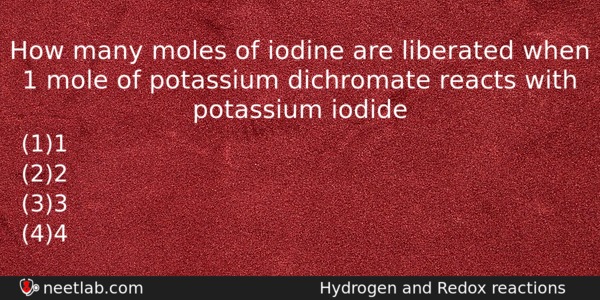
How many moles of iodine are liberated when 1 mole of potassium dichromate reacts with potassium iodide
Options
(a) 1
(b) 2
(c) 3
(d) 4
Correct Answer:
3
Explanation:
Iodine is liberated from potassium iodide.
K₂Cr₂O₇ + 4H₂SO₄ → K₂ SO₄+ Cr₂(SO₄)₃ + 4H₂O+ 3[O]
[2KI + H₂SO₄+[O] → K₂ SO₄ + I₂ +H₂O] ⨯ 3 /
[ K₂Cr₂O₇ + 6KI + 7H₂ SO₄ → 4K₂ SO₄+ Cr₂(SO₄)₃ + 7H₂O + 3I₂].
Related Questions: - The chemical substance used for the treatments of
- XeF₂ is isostructural with:
- dsp² hybridisation is found in
- The latest technique for the purification of organic concept is
- 20.0 g of a magnesium carbonate sample decomposes on heating to give carbon dioxide
Topics: Hydrogen and Redox Reactions
(174)
Subject: Chemistry
(2512)
Important MCQs Based on Medical Entrance Examinations To Improve Your NEET Score
- The chemical substance used for the treatments of
- XeF₂ is isostructural with:
- dsp² hybridisation is found in
- The latest technique for the purification of organic concept is
- 20.0 g of a magnesium carbonate sample decomposes on heating to give carbon dioxide
Topics: Hydrogen and Redox Reactions (174)
Subject: Chemistry (2512)
Important MCQs Based on Medical Entrance Examinations To Improve Your NEET Score
18000+ students are using NEETLab to improve their score. What about you?
Solve Previous Year MCQs, Mock Tests, Topicwise Practice Tests, Identify Weak Topics, Formula Flash cards and much more is available in NEETLab Android App to improve your NEET score.

Share this page with your friends
Leave a Reply