| ⇦ | 
| ⇨ |
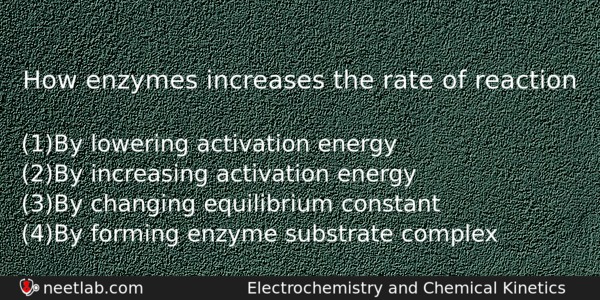
How enzymes increases the rate of reaction
Options
(a) By lowering activation energy
(b) By increasing activation energy
(c) By changing equilibrium constant
(d) By forming enzyme substrate complex
Correct Answer:
By lowering activation energy
Explanation:
No explanation available. Be the first to write the explanation for this question by commenting below.
Related Questions: - Which one of the following forms with an excess of CN⁻ (cyanide) a complex
- A mixture of two moles of carbon monoxide and one mole of oxygen
- N-terminal amino acids are identified by using
- When a common salt is added to the saponified product of oil, the soap is thrown
- The banana bond in diborane is constituted by
Topics: Electrochemistry and Chemical Kinetics
(87)
Subject: Chemistry
(2512)
Important MCQs Based on Medical Entrance Examinations To Improve Your NEET Score
- Which one of the following forms with an excess of CN⁻ (cyanide) a complex
- A mixture of two moles of carbon monoxide and one mole of oxygen
- N-terminal amino acids are identified by using
- When a common salt is added to the saponified product of oil, the soap is thrown
- The banana bond in diborane is constituted by
Topics: Electrochemistry and Chemical Kinetics (87)
Subject: Chemistry (2512)
Important MCQs Based on Medical Entrance Examinations To Improve Your NEET Score
18000+ students are using NEETLab to improve their score. What about you?
Solve Previous Year MCQs, Mock Tests, Topicwise Practice Tests, Identify Weak Topics, Formula Flash cards and much more is available in NEETLab Android App to improve your NEET score.

Share this page with your friends
Leave a Reply