| ⇦ | 
| ⇨ |
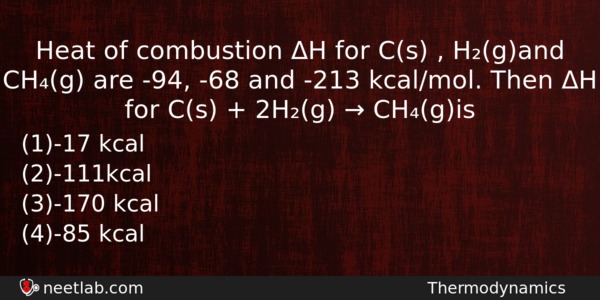
Heat of combustion ΔH for C(s) , H₂(g)and CH₄(g) are -94, -68 and -213 kcal/mol. Then ΔH for C(s) + 2H₂(g) → CH₄(g)is
Options
(a) -17 kcal
(b) -111kcal
(c) -170 kcal
(d) -85 kcal
Correct Answer:
-17 kcal
Explanation:
(i) C(s) + O₂ = CO₂ ; ΔH(i) = -94 kcal/mol,
(ii) 2H₂ + O₂ = 2H₂O ; ΔH(ii) = -68 x 2 kcal/mol,
(iii) CH₄ + 2O₂ = CO₂ + 2H₂O ; ΔH(iii) = -213 kcal/mol,
(iv) C(s) + 2H₂(g) = CH₄(g) ; ΔH(iv) = ?,
By applying Hess’s law we can compute ΔH(iv), (i) + (ii) – (iii), we have
C + O₂ + 2H₂ + O₂ – CH₄ – 2O₂ = CO₂ + 2H₂ O – CO₂ – 2H₂ O,
C+ 2H₂ = CH₄,
Therefore ΔH(iv) = ΔH(i) + ΔH(ii) – ΔH(iii) = (-94 – 68 x 2 + 213 ) kcal = -17 kcal.
Related Questions: - The energy of second Bhor orbit of the hydrogen atom is -328 kJ mol⁻¹, hence the enregy
- Reaction between an acyl halide and the sodium salt of a fatty acid results in
- How many calories are required to heat 40 gram of argon from 40⁰C to 100⁰C
- Natural polymer amongst the following is
- In which of the following reaction standard entropy change (ΔS⁰)
Topics: Thermodynamics
(179)
Subject: Chemistry
(2512)
Important MCQs Based on Medical Entrance Examinations To Improve Your NEET Score
- The energy of second Bhor orbit of the hydrogen atom is -328 kJ mol⁻¹, hence the enregy
- Reaction between an acyl halide and the sodium salt of a fatty acid results in
- How many calories are required to heat 40 gram of argon from 40⁰C to 100⁰C
- Natural polymer amongst the following is
- In which of the following reaction standard entropy change (ΔS⁰)
Topics: Thermodynamics (179)
Subject: Chemistry (2512)
Important MCQs Based on Medical Entrance Examinations To Improve Your NEET Score
18000+ students are using NEETLab to improve their score. What about you?
Solve Previous Year MCQs, Mock Tests, Topicwise Practice Tests, Identify Weak Topics, Formula Flash cards and much more is available in NEETLab Android App to improve your NEET score.

Share this page with your friends
Leave a Reply