| ⇦ | 
| ⇨ |
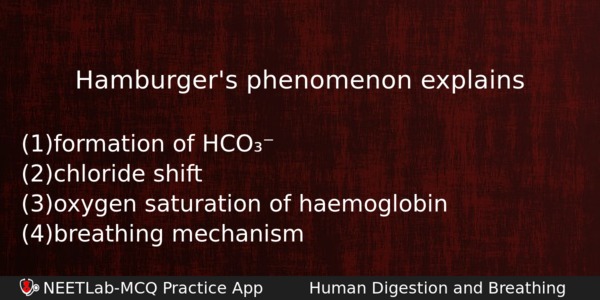
Hamburger’s phenomenon explains
Options
(a) formation of HCO₃⁻
(b) chloride shift
(c) oxygen saturation of haemoglobin
(d) breathing mechanism
Correct Answer:
chloride shift
Explanation:
Removal of CO₂from blood involves both influx of Cl ̄ions into RBCsand efflux of HCO₃ ̄ions from RBCs. Exit of bicarbonate ions, considerably change ionic balance between the plasma and the erythrocytes (RBCs). To restore this ionic balance, the chloride ions diffuse from the plasma into erythrocytes. This movement of chloride ions is called chloride shift (Hamburger’s phenomenon).
Related Questions: - In man, the blue eye colour is recessive to the brown eye colour. If the boy
- in thyroid follicle which type of epithelial tissue is present
- The term heterosis was first coined by
- Greatest problem in water conservation is to reduce the amount of
- Response to contact is known as
Topics: Human Digestion and Breathing
(167)
Subject: Biology
(4253)
Important MCQs Based on Medical Entrance Examinations To Improve Your NEET Score
- In man, the blue eye colour is recessive to the brown eye colour. If the boy
- in thyroid follicle which type of epithelial tissue is present
- The term heterosis was first coined by
- Greatest problem in water conservation is to reduce the amount of
- Response to contact is known as
Topics: Human Digestion and Breathing (167)
Subject: Biology (4253)
Important MCQs Based on Medical Entrance Examinations To Improve Your NEET Score
18000+ students are using NEETLab to improve their score. What about you?
Solve Previous Year MCQs, Mock Tests, Topicwise Practice Tests, Identify Weak Topics, Formula Flash cards and much more is available in NEETLab Android App to improve your NEET score.

Share this page with your friends
Leave a Reply