| ⇦ | 
| ⇨ |
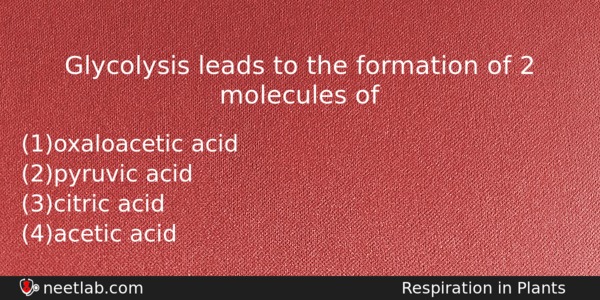
Glycolysis leads to the formation of 2 molecules of
Options
(a) oxaloacetic acid
(b) pyruvic acid
(c) citric acid
(d) acetic acid
Correct Answer:
pyruvic acid
Explanation:
The common aerobic respiration consists of three steps – glycolysis, krebs cycle and terminal oxidation. Glycolysis is the process of breakdown of glucose or similar hexose sugar to two molecules of pyruvic acid through a series of enzyme mediated reactions (occurs in cytosol) releasing some energy (as ATP) and reducing power (AS NADH₂). It is common to both plant and animal cells and to both aerobic and anaerobic modes of respiration.
Related Questions: - Embryo of sunflower has
- Nissl’s granules are found in cyton of nerve cells.These have affinity of basic
- Which one of the following elements is not an essential micronutrient for plant growth?
- Cowdung is appropriately used as
- What is vital capacity of our lungs?
Topics: Respiration in Plants
(184)
Subject: Biology
(4253)
Important MCQs Based on Medical Entrance Examinations To Improve Your NEET Score
- Embryo of sunflower has
- Nissl’s granules are found in cyton of nerve cells.These have affinity of basic
- Which one of the following elements is not an essential micronutrient for plant growth?
- Cowdung is appropriately used as
- What is vital capacity of our lungs?
Topics: Respiration in Plants (184)
Subject: Biology (4253)
Important MCQs Based on Medical Entrance Examinations To Improve Your NEET Score
18000+ students are using NEETLab to improve their score. What about you?
Solve Previous Year MCQs, Mock Tests, Topicwise Practice Tests, Identify Weak Topics, Formula Flash cards and much more is available in NEETLab Android App to improve your NEET score.

Share this page with your friends
Leave a Reply