| ⇦ | 
| ⇨ |
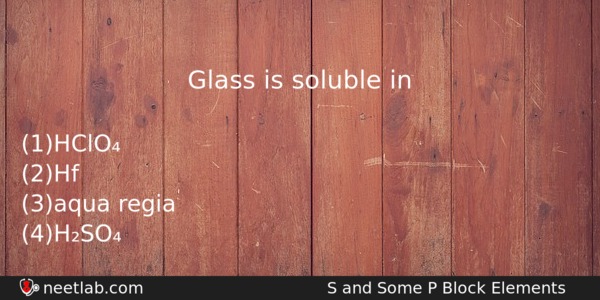
Glass is soluble in
Options
(a) HClO₄
(b) Hf
(c) aqua regia
(d) H₂SO₄
Correct Answer:
Hf
Explanation:
Unlike other halogen acids, HF acid attacks silica and glass. Glass being a mixture of sodium and calcium silicates reacts with HF forming soluble sodium and calcium fluorosilicates respectively. e.g., Na₂SiO₃ + 6HF → Na₂SiF₆ + 3H₂O, CaSiO₃ + 6HF → CaSiF₆ + 3H₂O.
Related Questions: - Acetyl salicylic acid is used as
- Assuming complete ionisation same moles of which of the following compounds
- A gas such as carbon monoxide would be most likely to obey the ideal gas law at
- The structure of XeOF₄ is
- Bithional is generally added to the soaps as an additive to function as a
Topics: S and Some P Block Elements
(157)
Subject: Chemistry
(2512)
Important MCQs Based on Medical Entrance Examinations To Improve Your NEET Score
- Acetyl salicylic acid is used as
- Assuming complete ionisation same moles of which of the following compounds
- A gas such as carbon monoxide would be most likely to obey the ideal gas law at
- The structure of XeOF₄ is
- Bithional is generally added to the soaps as an additive to function as a
Topics: S and Some P Block Elements (157)
Subject: Chemistry (2512)
Important MCQs Based on Medical Entrance Examinations To Improve Your NEET Score
18000+ students are using NEETLab to improve their score. What about you?
Solve Previous Year MCQs, Mock Tests, Topicwise Practice Tests, Identify Weak Topics, Formula Flash cards and much more is available in NEETLab Android App to improve your NEET score.

Share this page with your friends
Leave a Reply