| ⇦ | 
| ⇨ |
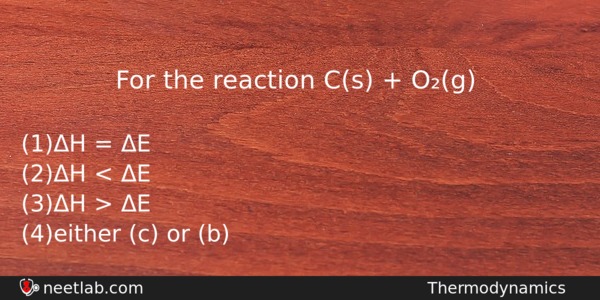
For the reaction C(s) + O₂(g)
Options
(a) ΔH = ΔE
(b) ΔH < ΔE
(c) ΔH > ΔE
(d) either ΔH > ΔE or ΔH < ΔE
Correct Answer:
ΔH = ΔE
Explanation:
In the reaction C(s) + O₂(g) → CO₂(g), there is no change in the number of moles of gaseous components (Δn = 1 – 1 = 0).
As ΔH = ΔE + ΔnRT. Thus in this case ΔH = ΔE.
Related Questions: - IN Haber process 30 L of dihydrogen and 30 L of dinitrogen were taken for reaction
- The boiling point of water decreases at higher altitudes because
- Which of the following element,has the same oxidation state in all of its com.
- Volume occupied by one molecule of water (density= 1 g cm⁻³) is
- The IUPAC name for Co(NH₃)₆Cl₃ is
Topics: Thermodynamics
(179)
Subject: Chemistry
(2512)
Important MCQs Based on Medical Entrance Examinations To Improve Your NEET Score
- IN Haber process 30 L of dihydrogen and 30 L of dinitrogen were taken for reaction
- The boiling point of water decreases at higher altitudes because
- Which of the following element,has the same oxidation state in all of its com.
- Volume occupied by one molecule of water (density= 1 g cm⁻³) is
- The IUPAC name for Co(NH₃)₆Cl₃ is
Topics: Thermodynamics (179)
Subject: Chemistry (2512)
Important MCQs Based on Medical Entrance Examinations To Improve Your NEET Score
18000+ students are using NEETLab to improve their score. What about you?
Solve Previous Year MCQs, Mock Tests, Topicwise Practice Tests, Identify Weak Topics, Formula Flash cards and much more is available in NEETLab Android App to improve your NEET score.

Share this page with your friends
Leave a Reply