| ⇦ | 
| ⇨ |
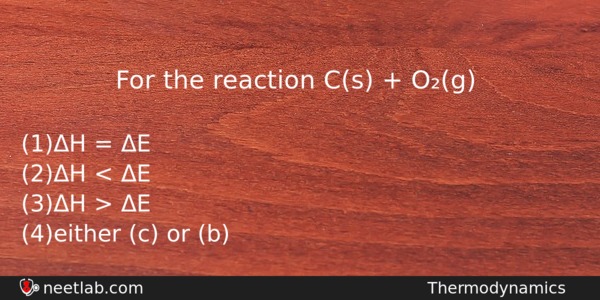
For the reaction C(s) + O₂(g)
Options
(a) ΔH = ΔE
(b) ΔH < ΔE
(c) ΔH > ΔE
(d) either ΔH > ΔE or ΔH < ΔE
Correct Answer:
ΔH = ΔE
Explanation:
In the reaction C(s) + O₂(g) → CO₂(g), there is no change in the number of moles of gaseous components (Δn = 1 – 1 = 0).
As ΔH = ΔE + ΔnRT. Thus in this case ΔH = ΔE.
Related Questions: - Which one of the following is most soluble
- According to Dalton’s atomic theory the smallest partical of the matter is called
- Benzaldehyde + NaOH produces which of the following
- Carbylamine reaction is given by
- Soap helps in cleaning the clothes because
Topics: Thermodynamics
(179)
Subject: Chemistry
(2512)
Important MCQs Based on Medical Entrance Examinations To Improve Your NEET Score
- Which one of the following is most soluble
- According to Dalton’s atomic theory the smallest partical of the matter is called
- Benzaldehyde + NaOH produces which of the following
- Carbylamine reaction is given by
- Soap helps in cleaning the clothes because
Topics: Thermodynamics (179)
Subject: Chemistry (2512)
Important MCQs Based on Medical Entrance Examinations To Improve Your NEET Score
18000+ students are using NEETLab to improve their score. What about you?
Solve Previous Year MCQs, Mock Tests, Topicwise Practice Tests, Identify Weak Topics, Formula Flash cards and much more is available in NEETLab Android App to improve your NEET score.

Share this page with your friends
Leave a Reply