| ⇦ | 
| ⇨ |
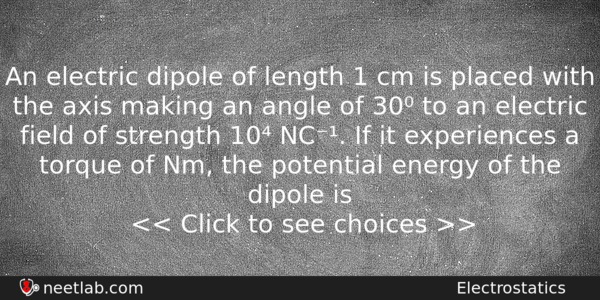
An electric dipole of length 1 cm is placed with the axis making an angle of 30⁰ to an electric field of strength 10⁴ NC⁻¹. If it experiences a torque of Nm, the potential energy of the dipole is
Options
(a) 2.45 J
(b) 0.0245 J
(c) 245.0 J
(d) 24.5 J
Correct Answer:
24.5 J
Explanation:
No explanation available. Be the first to write the explanation for this question by commenting below.
Related Questions: - Which of the following parameters does not characterize the thermodynamic state
- The photoelectric threshold wevelength for potassium (work function being 2 eV) is
- Ionization potential of hydrogen atom is 13.6 eV. Hydrogen atoms in the ground state
- Consider a compound slab consisting of two different materials having equal thickness
- Two planets at mean distances d₁ and d₂ from the sun have their frequencies n₁ and n₂
Topics: Electrostatics
(146)
Subject: Physics
(2479)
Important MCQs Based on Medical Entrance Examinations To Improve Your NEET Score
- Which of the following parameters does not characterize the thermodynamic state
- The photoelectric threshold wevelength for potassium (work function being 2 eV) is
- Ionization potential of hydrogen atom is 13.6 eV. Hydrogen atoms in the ground state
- Consider a compound slab consisting of two different materials having equal thickness
- Two planets at mean distances d₁ and d₂ from the sun have their frequencies n₁ and n₂
Topics: Electrostatics (146)
Subject: Physics (2479)
Important MCQs Based on Medical Entrance Examinations To Improve Your NEET Score
18000+ students are using NEETLab to improve their score. What about you?
Solve Previous Year MCQs, Mock Tests, Topicwise Practice Tests, Identify Weak Topics, Formula Flash cards and much more is available in NEETLab Android App to improve your NEET score.

Share this page with your friends
Torque=PE sin¢
10√2= P×10^4 sin 30°
P=2√2×10^-3
U=PE cos 30°
U=2√2×10^-3× 10^4 cos 30°
=24.5 J
Torque=PE sin¢
10√2= P×10^4 sin 30°
P=2√2×10^-3
U=PE cos 30°
U=2√2×10^-3× 10^4 cos 30°
=24.5 J
Torque=PE sin¢
10√2= P×10^4 sin 30°
P=2√2×10^-3
U=PE cos 30°
U=2√2×10^-3× 10^4 cos 30°
=24.5 J