| ⇦ | 
| ⇨ |
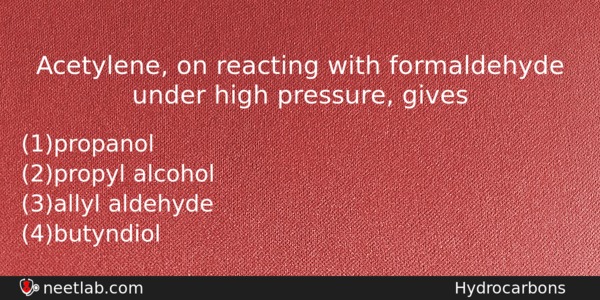
Acetylene, on reacting with formaldehyde under high pressure, gives
Options
(a) propanol
(b) propyl alcohol
(c) allyl aldehyde
(d) butyndiol
Correct Answer:
butyndiol
Explanation:
HC ≡ CH + HCHO (Acetylene) → HC ≡ C – CH₂OH (Formaldehyde)
HC ≡ C – CH₂OH + H – C = O → HOCH₂C ≡ CCH₂OH ( But – 2- yn-1,4-diol)
Related Questions: - Number of molecules in one litre of water is close to
- Which is purified by steam distillation
- Sodium thiosulphate is added in photography to
- Which of the following will be most stable diazonium salt RN₂⁺ X⁻
- Perchloric acid is prepared by the action of concentrated sulphuric acid on
Topics: Hydrocarbons
(84)
Subject: Chemistry
(2512)
Important MCQs Based on Medical Entrance Examinations To Improve Your NEET Score
- Number of molecules in one litre of water is close to
- Which is purified by steam distillation
- Sodium thiosulphate is added in photography to
- Which of the following will be most stable diazonium salt RN₂⁺ X⁻
- Perchloric acid is prepared by the action of concentrated sulphuric acid on
Topics: Hydrocarbons (84)
Subject: Chemistry (2512)
Important MCQs Based on Medical Entrance Examinations To Improve Your NEET Score
18000+ students are using NEETLab to improve their score. What about you?
Solve Previous Year MCQs, Mock Tests, Topicwise Practice Tests, Identify Weak Topics, Formula Flash cards and much more is available in NEETLab Android App to improve your NEET score.

Share this page with your friends
C2H2+2HCOH=OHCH2CCCH2OH