| ⇦ | 
| ⇨ |
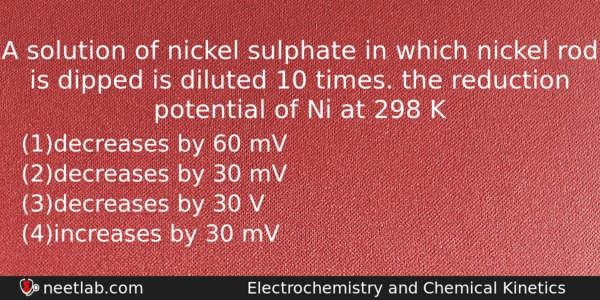
A solution of nickel sulphate in which nickel rod is dipped is diluted 10 times. the reduction potential of Ni at 298 K
Options
(a) decreases by 60 mV
(b) decreases by 30 mV
(c) decreases by 30 V
(d) increases by 30 mV
Correct Answer:
decreases by 30 mV
Explanation:
Let the initial concentration of Ni²⁺ = a. Since the solution is diluted 10 times, its concentration = a/10. Applying Nernst equation, E = E⁰ – 0.0591/2 log a /a/10. E = E⁰ – 0.030(log 10) ⇒ E = E⁰ – 0.030. Therefore the reduction potential of Ni decreases by 30 mV.
Related Questions: - The oxyacid of sulphur that contains a lone pair of electrons on sulphur is
- If Nₐ is Avagadro number then number of valence electrons in 4.2g of nitride
- The alkali halide that is soluble in pyridine is
- The ion that is isoelectronic with CO is
- Deficiency of vitamine B₁ causes the disease
Topics: Electrochemistry and Chemical Kinetics
(87)
Subject: Chemistry
(2512)
Important MCQs Based on Medical Entrance Examinations To Improve Your NEET Score
- The oxyacid of sulphur that contains a lone pair of electrons on sulphur is
- If Nₐ is Avagadro number then number of valence electrons in 4.2g of nitride
- The alkali halide that is soluble in pyridine is
- The ion that is isoelectronic with CO is
- Deficiency of vitamine B₁ causes the disease
Topics: Electrochemistry and Chemical Kinetics (87)
Subject: Chemistry (2512)
Important MCQs Based on Medical Entrance Examinations To Improve Your NEET Score
18000+ students are using NEETLab to improve their score. What about you?
Solve Previous Year MCQs, Mock Tests, Topicwise Practice Tests, Identify Weak Topics, Formula Flash cards and much more is available in NEETLab Android App to improve your NEET score.

Share this page with your friends
Leave a Reply