| ⇦ | 
| ⇨ |
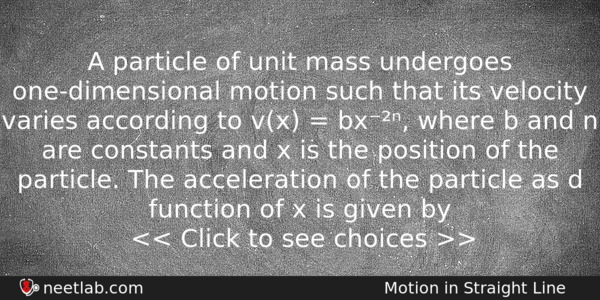
A particle of unit mass undergoes one-dimensional motion such that its velocity varies according to v(x) = bx⁻²ⁿ, where b and n are constants and x is the position of the particle. The acceleration of the particle as d function of x is given by
Options
(a) -2nb²x⁻⁴ⁿ⁻¹
(b) -2nb²x⁻²ⁿ⁺¹
(c) -2nb²e⁻⁴ⁿ⁺¹
(d) -2nb²x⁻²ⁿ⁻¹
Correct Answer:
-2nb²x⁻⁴ⁿ⁻¹
Explanation:
No explanation available. Be the first to write the explanation for this question by commenting below.
Related Questions: - In a Rutherford scattering experiment when a projectile of charge Z₁ and mass M₁
- Consider a two particle system with particle having masses m₁ and m₂. If the first
- The molar specific heats of an ideal gas at constant pressure and volume are denoted
- Photons with energy 5eV are incident on a cathode C in a photoelectric cell.
- The reddish appearance of the sun at sunrise and sunset is due to
Topics: Motion in Straight Line
(93)
Subject: Physics
(2479)
Important MCQs Based on Medical Entrance Examinations To Improve Your NEET Score
- In a Rutherford scattering experiment when a projectile of charge Z₁ and mass M₁
- Consider a two particle system with particle having masses m₁ and m₂. If the first
- The molar specific heats of an ideal gas at constant pressure and volume are denoted
- Photons with energy 5eV are incident on a cathode C in a photoelectric cell.
- The reddish appearance of the sun at sunrise and sunset is due to
Topics: Motion in Straight Line (93)
Subject: Physics (2479)
Important MCQs Based on Medical Entrance Examinations To Improve Your NEET Score
18000+ students are using NEETLab to improve their score. What about you?
Solve Previous Year MCQs, Mock Tests, Topicwise Practice Tests, Identify Weak Topics, Formula Flash cards and much more is available in NEETLab Android App to improve your NEET score.

Share this page with your friends
Leave a Reply