| ⇦ | 
| ⇨ |
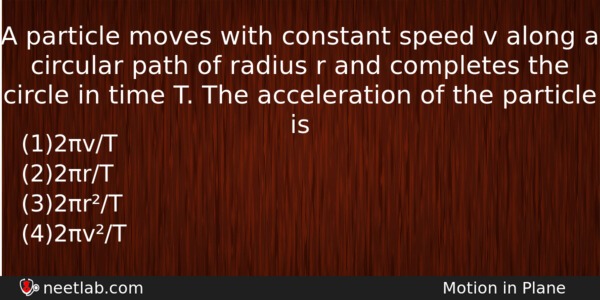
A particle moves with constant speed v along a circular path of radius r and completes the circle in time T. The acceleration of the particle is
Options
(a) 2πv/T
(b) 2πr/T
(c) 2πr²/T
(d) 2πv²/T
Correct Answer:
2πv/T
Explanation:
Centripetal acceleration = v² / R = v × (v/R) a = v × ω (Therefore, ω = v/R) a = (v × 2π)/T.
Related Questions: - A wind with speed 40 m/s blows parallel to the roof of a house. The area of the roof
- For transistor action (1) Base, emitter and collector regions should have similar size
- The minimum wavelength of X-rays emitted by X-ray tube is 0.4125Å
- The primary of a transformer when connected to a dc battery of 10 volt draws a current
- A block of mass m is moving on a wedge with the acceleration aᵒ
Topics: Motion in Plane
(93)
Subject: Physics
(2479)
Important MCQs Based on Medical Entrance Examinations To Improve Your NEET Score
- A wind with speed 40 m/s blows parallel to the roof of a house. The area of the roof
- For transistor action (1) Base, emitter and collector regions should have similar size
- The minimum wavelength of X-rays emitted by X-ray tube is 0.4125Å
- The primary of a transformer when connected to a dc battery of 10 volt draws a current
- A block of mass m is moving on a wedge with the acceleration aᵒ
Topics: Motion in Plane (93)
Subject: Physics (2479)
Important MCQs Based on Medical Entrance Examinations To Improve Your NEET Score
18000+ students are using NEETLab to improve their score. What about you?
Solve Previous Year MCQs, Mock Tests, Topicwise Practice Tests, Identify Weak Topics, Formula Flash cards and much more is available in NEETLab Android App to improve your NEET score.

Share this page with your friends
Leave a Reply