| ⇦ | 
| ⇨ |
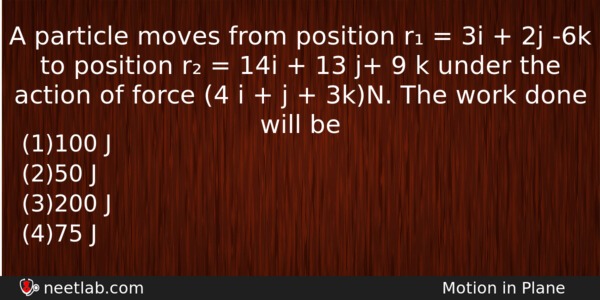
A particle moves from position r₁ = 3i + 2j -6k to position r₂ = 14i + 13 j+ 9 k under the action of force (4 i + j + 3k)N. The work done will be
Options
(a) 100 J
(b) 50 J
(c) 200 J
(d) 75 J
Correct Answer:
100 J
Explanation:
No explanation available. Be the first to write the explanation for this question by commenting below.
Related Questions: - A body of mass (4m) is lying in x-y plane at rest. It suddenly explodes into three
- The ratio of the nuclear radii of elements with mass numbers 216 and 125 is
- The electric field associated with an e.m. wave in vacuum is given by
- If the ionisation energy for the hydrogen atom is 13.6 eV, the energy required
- A tuning fork frequency 512 Hz is vibrated with a sonometer wire and 6 beats per second
Topics: Motion in Plane
(93)
Subject: Physics
(2479)
Important MCQs Based on Medical Entrance Examinations To Improve Your NEET Score
- A body of mass (4m) is lying in x-y plane at rest. It suddenly explodes into three
- The ratio of the nuclear radii of elements with mass numbers 216 and 125 is
- The electric field associated with an e.m. wave in vacuum is given by
- If the ionisation energy for the hydrogen atom is 13.6 eV, the energy required
- A tuning fork frequency 512 Hz is vibrated with a sonometer wire and 6 beats per second
Topics: Motion in Plane (93)
Subject: Physics (2479)
Important MCQs Based on Medical Entrance Examinations To Improve Your NEET Score
18000+ students are using NEETLab to improve their score. What about you?
Solve Previous Year MCQs, Mock Tests, Topicwise Practice Tests, Identify Weak Topics, Formula Flash cards and much more is available in NEETLab Android App to improve your NEET score.

Share this page with your friends
Leave a Reply