| ⇦ | 
| ⇨ |
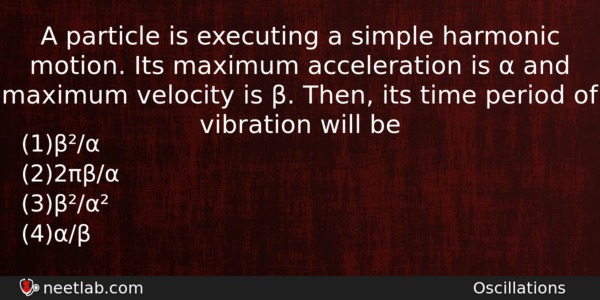
A particle is executing a simple harmonic motion. Its maximum acceleration is α and maximum velocity is β. Then, its time period of vibration will be
Options
(a) β²/α
(b) 2πβ/α
(c) β²/α²
(d) α/β
Correct Answer:
2πβ/α
Explanation:
As, we know, in Simple Harmonic Motion
Maximum acceleration of the particle, α = Aω²
Maximum velocity, β = Aω
⇒ ω = α / β
⇒ T = 2π / ω = 2πβ / α [Since, ω = 2π / T].
Related Questions: - In a pure capacitive A.C circuit, current and voltage differ in phase by
- An explosion breaks a rock into three parts in a horizontal plane
- A ship of mass 3 x 10⁷ kg initially at rest is pulled by a force of 5 x 10⁴ N through
- A electric dipole is placed at an angle of 30⁰ to a non-uniform electric field.
- Given A=4i+6j and B=2i+3j. Which of the following is correct?
Topics: Oscillations
(58)
Subject: Physics
(2479)
Important MCQs Based on Medical Entrance Examinations To Improve Your NEET Score
- In a pure capacitive A.C circuit, current and voltage differ in phase by
- An explosion breaks a rock into three parts in a horizontal plane
- A ship of mass 3 x 10⁷ kg initially at rest is pulled by a force of 5 x 10⁴ N through
- A electric dipole is placed at an angle of 30⁰ to a non-uniform electric field.
- Given A=4i+6j and B=2i+3j. Which of the following is correct?
Topics: Oscillations (58)
Subject: Physics (2479)
Important MCQs Based on Medical Entrance Examinations To Improve Your NEET Score
18000+ students are using NEETLab to improve their score. What about you?
Solve Previous Year MCQs, Mock Tests, Topicwise Practice Tests, Identify Weak Topics, Formula Flash cards and much more is available in NEETLab Android App to improve your NEET score.

Share this page with your friends
Leave a Reply