| ⇦ | 
| ⇨ |
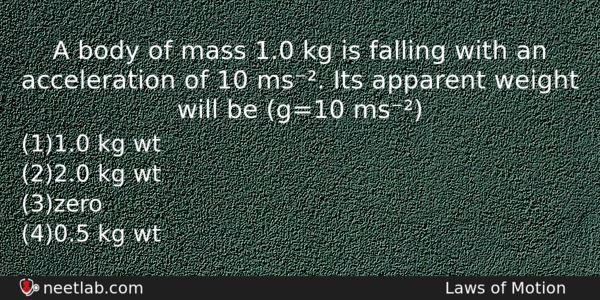
A body of mass 1.0 kg is falling with an acceleration of 10 ms⁻². Its apparent weight will be (g=10 ms⁻²)
Options
(a) 1.0 kg wt
(b) 2.0 kg wt
(c) zero
(d) 0.5 kg wt
Correct Answer:
zero
Explanation:
R = m (g – a) = m (10 – 10) = zero
This answer is an extension of the lift problem. Actually mg is the force acting on the mass m. As potential energy decreases, its kinetic energy increases as experienced. The question is not correct.
Related Questions: - An electric bulb has a rated power of 50W at 100 V. if it used on an a.c. source
- The ratio of speed of an electron in ground state in Bohr’s first orbit of hydrogen atom
- If a solid sphere of mass 1 kg and radius 0.1 m rolls without slipping at a uniform
- The conducting loop in the form of a circle is placed in a uniform magneitc field
- Which of the following is true for number of spectral lines in going from Lyman series
Topics: Laws of Motion
(103)
Subject: Physics
(2479)
Important MCQs Based on Medical Entrance Examinations To Improve Your NEET Score
- An electric bulb has a rated power of 50W at 100 V. if it used on an a.c. source
- The ratio of speed of an electron in ground state in Bohr’s first orbit of hydrogen atom
- If a solid sphere of mass 1 kg and radius 0.1 m rolls without slipping at a uniform
- The conducting loop in the form of a circle is placed in a uniform magneitc field
- Which of the following is true for number of spectral lines in going from Lyman series
Topics: Laws of Motion (103)
Subject: Physics (2479)
Important MCQs Based on Medical Entrance Examinations To Improve Your NEET Score
18000+ students are using NEETLab to improve their score. What about you?
Solve Previous Year MCQs, Mock Tests, Topicwise Practice Tests, Identify Weak Topics, Formula Flash cards and much more is available in NEETLab Android App to improve your NEET score.

Share this page with your friends
Leave a Reply