| ⇦ | 
| ⇨ |
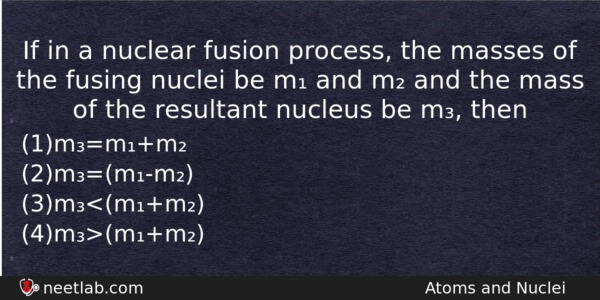
If in a nuclear fusion process, the masses of the fusing nuclei be m₁ and m₂ and the mass of the resultant nucleus be m₃, then
Options
(a) m₃=m₁+m₂
(b) m₃=(m₁-m₂)
(c) m₃<(m₁+m₂)
(d) m₃>(m₁+m₂)
Correct Answer:
m₃<(m₁+m₂)
Explanation:
(m₁+m₂) = m₃ + binding energy equivalent to mass
⇒ (m₁+m₂) > m₃
⇒ m₃<(m₁+m₂)
Related Questions: - The work of 146 kJ is performed in order to compress one kilo mole fo gas adiabatically
- Charge density for intrinsic semiconductor will be
- Two pendulums A and B are oscillating simultaneously with time period
- In Young’s experiment, the ratio of maximum to minimum intensities of the fringe
- Which of the following is the function of the step-up transformer?
Topics: Atoms and Nuclei
(136)
Subject: Physics
(2479)
Important MCQs Based on Medical Entrance Examinations To Improve Your NEET Score
- The work of 146 kJ is performed in order to compress one kilo mole fo gas adiabatically
- Charge density for intrinsic semiconductor will be
- Two pendulums A and B are oscillating simultaneously with time period
- In Young’s experiment, the ratio of maximum to minimum intensities of the fringe
- Which of the following is the function of the step-up transformer?
Topics: Atoms and Nuclei (136)
Subject: Physics (2479)
Important MCQs Based on Medical Entrance Examinations To Improve Your NEET Score
18000+ students are using NEETLab to improve their score. What about you?
Solve Previous Year MCQs, Mock Tests, Topicwise Practice Tests, Identify Weak Topics, Formula Flash cards and much more is available in NEETLab Android App to improve your NEET score.

Share this page with your friends
Leave a Reply