| ⇦ | 
| ⇨ |
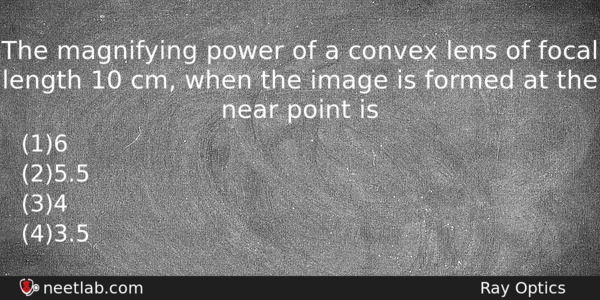
The magnifying power of a convex lens of focal length 10 cm, when the image is formed at the near point is
Options
(a) 6
(b) 5.5
(c) 4
(d) 3.5
Correct Answer:
3.5
Explanation:
No explanation available. Be the first to write the explanation for this question by commenting below.
Related Questions: - A particle is executing SHM along a straight line. Its velocities at distances
- A change of 0.04 V takes place between the base and the emitter when an input
- A hemispherical bowl of radius R is rotating about its axis of symmetry
- Electrons used in an electron microscope are accelerated by a voltage of 25 kV
- In a n-p-n transistor about 10¹⁰ electrons enter the emitter in 2 μs,
Topics: Ray Optics
(94)
Subject: Physics
(2479)
Important MCQs Based on Medical Entrance Examinations To Improve Your NEET Score
- A particle is executing SHM along a straight line. Its velocities at distances
- A change of 0.04 V takes place between the base and the emitter when an input
- A hemispherical bowl of radius R is rotating about its axis of symmetry
- Electrons used in an electron microscope are accelerated by a voltage of 25 kV
- In a n-p-n transistor about 10¹⁰ electrons enter the emitter in 2 μs,
Topics: Ray Optics (94)
Subject: Physics (2479)
Important MCQs Based on Medical Entrance Examinations To Improve Your NEET Score
18000+ students are using NEETLab to improve their score. What about you?
Solve Previous Year MCQs, Mock Tests, Topicwise Practice Tests, Identify Weak Topics, Formula Flash cards and much more is available in NEETLab Android App to improve your NEET score.

Share this page with your friends
explanation plzzz
M=1+d/f
We know that d is always 25 cm so by putting values you can get the answer…. thank you