| ⇦ | 
| ⇨ |
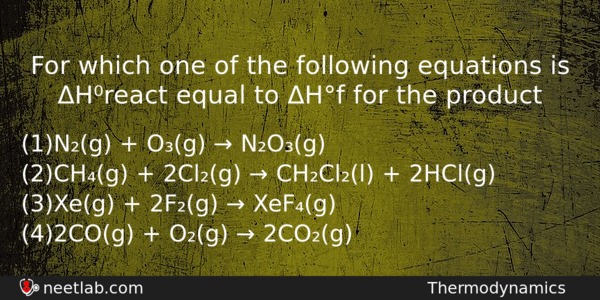
For which one of the following equations is ΔH⁰react equal to ΔH°f for the product
Options
(a) N₂(g) + O₃(g) → N₂O₃(g)
(b) CH₄(g) + 2Cl₂(g) → CH₂Cl₂(l) + 2HCl(g)
(c) Xe(g) + 2F₂(g) → XeF₄(g)
(d) 2CO(g) + O₂(g) → 2CO₂(g)
Correct Answer:
Xe(g) + 2F₂(g) → XeF₄(g)
Explanation:
No explanation available. Be the first to write the explanation for this question by commenting below.
Related Questions: - Which of the following inert gases does not have eight electrons
- Atoms in a P₄ molecule of white phosphorus are arranged regularly in the follow
- The compounds having only primary hydrogen atoms is
- In third group, iron gives blood red colouration with ammonium thiocyanate
- A unit cell of sodium chloride has four formula units.The edge length of the unit cell
Topics: Thermodynamics
(179)
Subject: Chemistry
(2512)
Important MCQs Based on Medical Entrance Examinations To Improve Your NEET Score
- Which of the following inert gases does not have eight electrons
- Atoms in a P₄ molecule of white phosphorus are arranged regularly in the follow
- The compounds having only primary hydrogen atoms is
- In third group, iron gives blood red colouration with ammonium thiocyanate
- A unit cell of sodium chloride has four formula units.The edge length of the unit cell
Topics: Thermodynamics (179)
Subject: Chemistry (2512)
Important MCQs Based on Medical Entrance Examinations To Improve Your NEET Score
18000+ students are using NEETLab to improve their score. What about you?
Solve Previous Year MCQs, Mock Tests, Topicwise Practice Tests, Identify Weak Topics, Formula Flash cards and much more is available in NEETLab Android App to improve your NEET score.

Share this page with your friends
Leave a Reply