| ⇦ | 
| ⇨ |
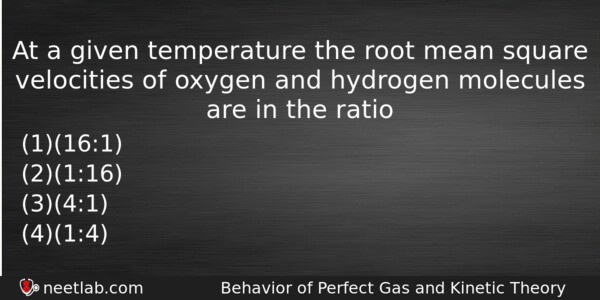
At a given temperature the root mean square velocities of oxygen and hydrogen molecules are in the ratio
Options
(a) (16:1)
(b) (1:16)
(c) (4:1)
(d) (1:4)
Correct Answer:
(1:4)
Explanation:
v(rms) = √(3RT / M)
Where M is the molecular mass
Since the temperature remains the same
v(rms) ∝ 1 / √M
[v(rms)]o₂ / [v(rms)]ʜ₂ = √(Mʜ₂ / Mo₂) = √(2 / 32) = 1 / 4
Related Questions: - For having large magnification power of a compound microscope
- A particle of mass M is executing oscillations about the origin on the x-axis.
- Order of e/m ratio of proton, α-particle and electron is
- If a body travels half the distance with velocity v1 and the next half with velocity v2
- The position x of a particle with respect to time t along x-axis is given
Topics: Behavior of Perfect Gas and Kinetic Theory
(34)
Subject: Physics
(2479)
Important MCQs Based on Medical Entrance Examinations To Improve Your NEET Score
- For having large magnification power of a compound microscope
- A particle of mass M is executing oscillations about the origin on the x-axis.
- Order of e/m ratio of proton, α-particle and electron is
- If a body travels half the distance with velocity v1 and the next half with velocity v2
- The position x of a particle with respect to time t along x-axis is given
Topics: Behavior of Perfect Gas and Kinetic Theory (34)
Subject: Physics (2479)
Important MCQs Based on Medical Entrance Examinations To Improve Your NEET Score
18000+ students are using NEETLab to improve their score. What about you?
Solve Previous Year MCQs, Mock Tests, Topicwise Practice Tests, Identify Weak Topics, Formula Flash cards and much more is available in NEETLab Android App to improve your NEET score.

Share this page with your friends
Leave a Reply