| ⇦ | 
| ⇨ |
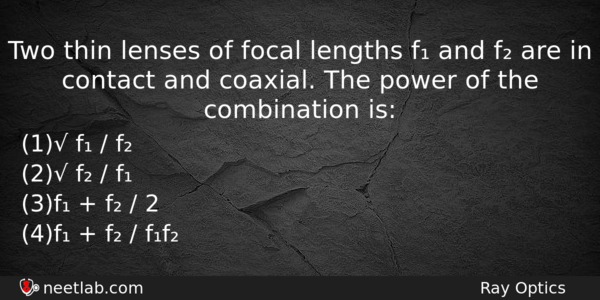
Two thin lenses of focal lengths f₁ and f₂ are in contact and coaxial. The power of the combination is:
Options
(a) √ f₁ / f₂
(b) √ f₂ / f₁
(c) f₁ + f₂ / 2
(d) f₁ + f₂ / f₁f₂
Correct Answer:
f₁ + f₂ / f₁f₂
Explanation:
The focal length of the combination
1/f = 1/f₁ + 1/f₂
Power of the combinations,
P = f₁ + f₂ / f₁ f₂ ( P = 1 / f )
Related Questions: - A dip needle vibrates in a vertical plane perpendicular to magnetic meridian. The time
- A thin circular ring of mass M and radius R is rotating in a horizontal plane about
- The inductive reactance of an inductor of 1/π henry at 50 Hz frequency is
- The physical quantities not having same dimensions are
- Parsec is the unit of
Topics: Ray Optics
(94)
Subject: Physics
(2479)
Important MCQs Based on Medical Entrance Examinations To Improve Your NEET Score
- A dip needle vibrates in a vertical plane perpendicular to magnetic meridian. The time
- A thin circular ring of mass M and radius R is rotating in a horizontal plane about
- The inductive reactance of an inductor of 1/π henry at 50 Hz frequency is
- The physical quantities not having same dimensions are
- Parsec is the unit of
Topics: Ray Optics (94)
Subject: Physics (2479)
Important MCQs Based on Medical Entrance Examinations To Improve Your NEET Score
18000+ students are using NEETLab to improve their score. What about you?
Solve Previous Year MCQs, Mock Tests, Topicwise Practice Tests, Identify Weak Topics, Formula Flash cards and much more is available in NEETLab Android App to improve your NEET score.

Share this page with your friends
Leave a Reply