| ⇦ | 
| ⇨ |
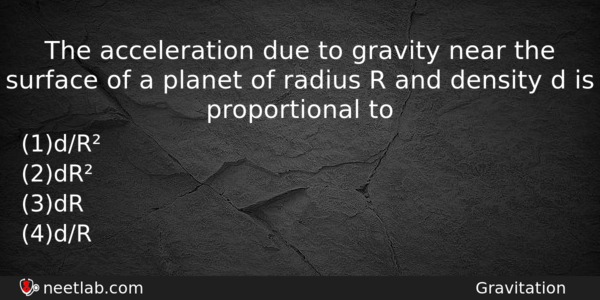
The acceleration due to gravity near the surface of a planet of radius R and density d is proportional to
Options
(a) d/R²
(b) dR²
(c) dR
(d) d/R
Correct Answer:
dR
Explanation:
g=GM/R²
(M=Mass of the earth); (R=Distance of body from centre of earth)
g=G Volume x density / R²
Volume of the sphere=4/3 πR³
Therefore, g=G.4/3 πR³.d / R²
g=G 4/3 πRd
g=4πG/3.dR
g is proportional to dR
Related Questions: - A glass slab consists of thin uniform layers of progressively decreasing refractive
- The cylindrical tube of a spray pump has radius R, one end of which has n fine holes,
- A string is stretched between fixed points seperated by 75 cm. It is observed
- Acceleration of a particle, executing SHM, at its mean position is
- Water rises to a height h in capillary tube. If the length of capillary tube above
Topics: Gravitation
(63)
Subject: Physics
(2479)
Important MCQs Based on Medical Entrance Examinations To Improve Your NEET Score
- A glass slab consists of thin uniform layers of progressively decreasing refractive
- The cylindrical tube of a spray pump has radius R, one end of which has n fine holes,
- A string is stretched between fixed points seperated by 75 cm. It is observed
- Acceleration of a particle, executing SHM, at its mean position is
- Water rises to a height h in capillary tube. If the length of capillary tube above
Topics: Gravitation (63)
Subject: Physics (2479)
Important MCQs Based on Medical Entrance Examinations To Improve Your NEET Score
18000+ students are using NEETLab to improve their score. What about you?
Solve Previous Year MCQs, Mock Tests, Topicwise Practice Tests, Identify Weak Topics, Formula Flash cards and much more is available in NEETLab Android App to improve your NEET score.

Share this page with your friends
Leave a Reply