| ⇦ | 
| ⇨ |
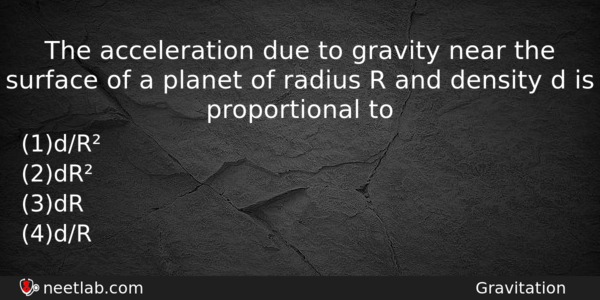
The acceleration due to gravity near the surface of a planet of radius R and density d is proportional to
Options
(a) d/R²
(b) dR²
(c) dR
(d) d/R
Correct Answer:
dR
Explanation:
g=GM/R²
(M=Mass of the earth); (R=Distance of body from centre of earth)
g=G Volume x density / R²
Volume of the sphere=4/3 πR³
Therefore, g=G.4/3 πR³.d / R²
g=G 4/3 πRd
g=4πG/3.dR
g is proportional to dR
Related Questions: - Depletion layer contains
- An open pipe resonates with a tuning fork of frequency 500 Hz. It is observed
- A electric dipole is placed at an angle of 30⁰ to a non-uniform electric field.
- The horizontal range and maximum height of a projectile are equal.The angle of projection
- By the succesive disintegration of ₉₂U²³⁸, the final product obtained is ₈₂Pb²⁰⁶, then
Topics: Gravitation
(63)
Subject: Physics
(2479)
Important MCQs Based on Medical Entrance Examinations To Improve Your NEET Score
- Depletion layer contains
- An open pipe resonates with a tuning fork of frequency 500 Hz. It is observed
- A electric dipole is placed at an angle of 30⁰ to a non-uniform electric field.
- The horizontal range and maximum height of a projectile are equal.The angle of projection
- By the succesive disintegration of ₉₂U²³⁸, the final product obtained is ₈₂Pb²⁰⁶, then
Topics: Gravitation (63)
Subject: Physics (2479)
Important MCQs Based on Medical Entrance Examinations To Improve Your NEET Score
18000+ students are using NEETLab to improve their score. What about you?
Solve Previous Year MCQs, Mock Tests, Topicwise Practice Tests, Identify Weak Topics, Formula Flash cards and much more is available in NEETLab Android App to improve your NEET score.

Share this page with your friends
Leave a Reply