| ⇦ | 
| ⇨ |
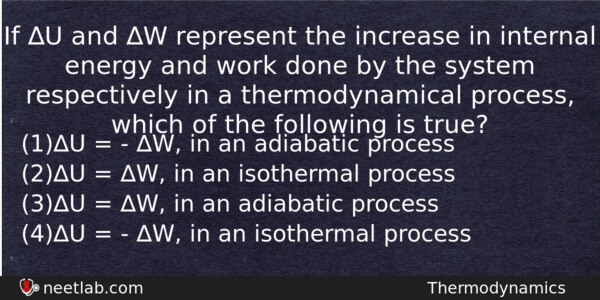
If ∆U and ∆W represent the increase in internal energy and work done by the system respectively in a thermodynamical process, which of the following is true?
Options
(a) ∆U = – ∆W, in an adiabatic process
(b) ∆U = ∆W, in an isothermal process
(c) ∆U = ∆W, in an adiabatic process
(d) ∆U = – ∆W, in an isothermal process
Correct Answer:
∆U = – ∆W, in an adiabatic process
Explanation:
BY first law of thermodynamics, ∆Q = ∆U + ∆W
In adiabatic process, ∆Q = 0 ∆U = – ∆W
In isothermal process, ∆U = 0 ∆Q = ∆W
Related Questions: - SI unit of magnetic dipole moment is
- If a charge in current of 0.01 A in one coil produces a change in magnetic flux
- When a biconvex lens of glass having refractive index 1.47 is dipped in a liquid
- The unit of electric permittivity is
- The maximum kinetic energy of emitted electrons in a photoelectric effect
Topics: Thermodynamics
(179)
Subject: Physics
(2479)
Important MCQs Based on Medical Entrance Examinations To Improve Your NEET Score
- SI unit of magnetic dipole moment is
- If a charge in current of 0.01 A in one coil produces a change in magnetic flux
- When a biconvex lens of glass having refractive index 1.47 is dipped in a liquid
- The unit of electric permittivity is
- The maximum kinetic energy of emitted electrons in a photoelectric effect
Topics: Thermodynamics (179)
Subject: Physics (2479)
Important MCQs Based on Medical Entrance Examinations To Improve Your NEET Score
18000+ students are using NEETLab to improve their score. What about you?
Solve Previous Year MCQs, Mock Tests, Topicwise Practice Tests, Identify Weak Topics, Formula Flash cards and much more is available in NEETLab Android App to improve your NEET score.

Share this page with your friends
Leave a Reply