| ⇦ | 
| ⇨ |
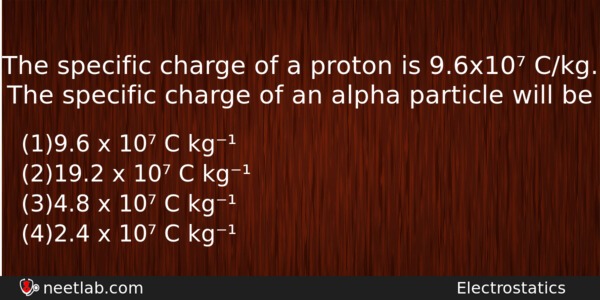
The specific charge of a proton is 9.6×10⁷ C/kg. The specific charge of an alpha particle will be
Options
(a) 9.6 x 10⁷ C kg⁻¹
(b) 19.2 x 10⁷ C kg⁻¹
(c) 4.8 x 10⁷ C kg⁻¹
(d) 2.4 x 10⁷ C kg⁻¹
Correct Answer:
4.8 x 10⁷ C kg⁻¹
Explanation:
For proton, specific charge = e / m = 9.6 × 10⁷ C kg⁻¹
For alpha particle, specific charge = 2e / 4m = 1e / 2m
= (1/2) × 9.6 × 10⁷ = 4.8 × 10⁷ C kg⁻¹
Related Questions: - Huygen’s principle of secondary wavelets may be used to
- If A=3i+4j and B=7i+24j the vector having the same magnitude as B and parallel to A is
- Out of the following options which one can be used to produce a propagating
- Photons of 5.5 eV energy fall on the surface of the metal emitting photoelectrons
- Two tangent galvanometers A and B have coils of radii 8 cm and 16 cm respectively
Topics: Electrostatics
(146)
Subject: Physics
(2479)
Important MCQs Based on Medical Entrance Examinations To Improve Your NEET Score
- Huygen’s principle of secondary wavelets may be used to
- If A=3i+4j and B=7i+24j the vector having the same magnitude as B and parallel to A is
- Out of the following options which one can be used to produce a propagating
- Photons of 5.5 eV energy fall on the surface of the metal emitting photoelectrons
- Two tangent galvanometers A and B have coils of radii 8 cm and 16 cm respectively
Topics: Electrostatics (146)
Subject: Physics (2479)
Important MCQs Based on Medical Entrance Examinations To Improve Your NEET Score
18000+ students are using NEETLab to improve their score. What about you?
Solve Previous Year MCQs, Mock Tests, Topicwise Practice Tests, Identify Weak Topics, Formula Flash cards and much more is available in NEETLab Android App to improve your NEET score.

Share this page with your friends
Leave a Reply