| ⇦ | 
| ⇨ |
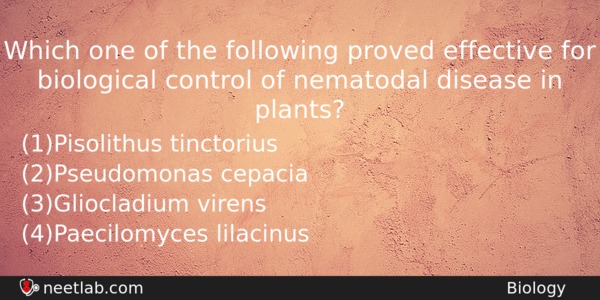
Which one of the following proved effective for biological control of nematodal disease in plants?
Options
(a) Pisolithus tinctorius
(b) Pseudomonas cepacia
(c) Gliocladium virens
(d) Paecilomyces lilacinus
Correct Answer:
Gliocladium virens
Explanation:
No explanation available. Be the first to write the explanation for this question by commenting below.
Related Questions: - Perisperm is
- In Kreb’s cycle GTP is formed in
- Gene regulation governing lactose operon of E.coli that involves the lac I gene
- Secondary growth do not occur in
- The basic functional unit of human kidney is
Topics: Enhancement in Food Production
(101)
Subject: Biology
(4253)
Important MCQs Based on Medical Entrance Examinations To Improve Your NEET Score
- Perisperm is
- In Kreb’s cycle GTP is formed in
- Gene regulation governing lactose operon of E.coli that involves the lac I gene
- Secondary growth do not occur in
- The basic functional unit of human kidney is
Topics: Enhancement in Food Production (101)
Subject: Biology (4253)
Important MCQs Based on Medical Entrance Examinations To Improve Your NEET Score
18000+ students are using NEETLab to improve their score. What about you?
Solve Previous Year MCQs, Mock Tests, Topicwise Practice Tests, Identify Weak Topics, Formula Flash cards and much more is available in NEETLab Android App to improve your NEET score.

Share this page with your friends
Leave a Reply