| ⇦ | 
| ⇨ |
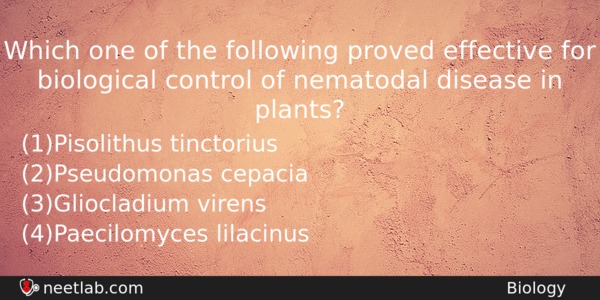
Which one of the following proved effective for biological control of nematodal disease in plants?
Options
(a) Pisolithus tinctorius
(b) Pseudomonas cepacia
(c) Gliocladium virens
(d) Paecilomyces lilacinus
Correct Answer:
Gliocladium virens
Explanation:
No explanation available. Be the first to write the explanation for this question by commenting below.
Related Questions: - In a typical eukaryotic cell cycle Gap 1 synthesis and Gap 2 are the three
- As compared to rods the cones aretimes less sensitive
- Heterozygosity is most favoured in plants following
- Frogs and toads belong to the order
- Bubonic plague’ is transmitted by
Topics: Enhancement in Food Production
(101)
Subject: Biology
(4253)
Important MCQs Based on Medical Entrance Examinations To Improve Your NEET Score
- In a typical eukaryotic cell cycle Gap 1 synthesis and Gap 2 are the three
- As compared to rods the cones aretimes less sensitive
- Heterozygosity is most favoured in plants following
- Frogs and toads belong to the order
- Bubonic plague’ is transmitted by
Topics: Enhancement in Food Production (101)
Subject: Biology (4253)
Important MCQs Based on Medical Entrance Examinations To Improve Your NEET Score
18000+ students are using NEETLab to improve their score. What about you?
Solve Previous Year MCQs, Mock Tests, Topicwise Practice Tests, Identify Weak Topics, Formula Flash cards and much more is available in NEETLab Android App to improve your NEET score.

Share this page with your friends
Leave a Reply