| ⇦ | 
| ⇨ |
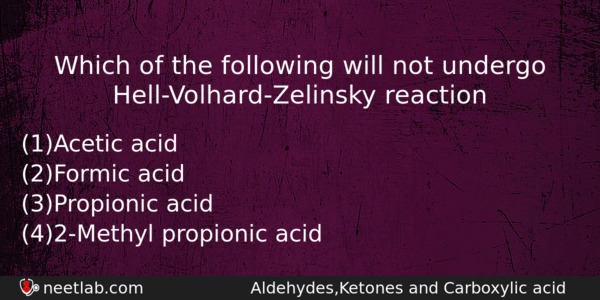
Which of the following will not undergo Hell-Volhard-Zelinsky reaction
Options
(a) Acetic acid
(b) Formic acid
(c) Propionic acid
(d) 2-Methyl propionic acid
Correct Answer:
Formic acid
Explanation:
Carboxylic acid which contain α – hydrogen atom reacts with chlorine or bromine in presence of red phosphorus to give α – chloro or α – bromo acids. This reaction is called H.V.Z (Hell Volhard Zelinsky ) reaction. CH₃COOH → CCl₃COOH(trichloroacetic acid). CH₃CH₂COOH → CH₃CBr₂COOH (α,α-dibromopropionic acid) Due to absence of α – H atom HCOOH does not undergo HVZ reaction.
Related Questions: - The reaction : Ag²⁺(aq) + Ag(s) ⇌ 2Ag⁺(aq) is an example of
- The absorption of hydrogen by palladium is called
- Among the following sols the one which is hydrophobic is
- Hydrogen cannot be obtained by
- Chemical bond implies
Topics: Aldehydes Ketones and Carboxylic Acid
(89)
Subject: Chemistry
(2512)
Important MCQs Based on Medical Entrance Examinations To Improve Your NEET Score
- The reaction : Ag²⁺(aq) + Ag(s) ⇌ 2Ag⁺(aq) is an example of
- The absorption of hydrogen by palladium is called
- Among the following sols the one which is hydrophobic is
- Hydrogen cannot be obtained by
- Chemical bond implies
Topics: Aldehydes Ketones and Carboxylic Acid (89)
Subject: Chemistry (2512)
Important MCQs Based on Medical Entrance Examinations To Improve Your NEET Score
18000+ students are using NEETLab to improve their score. What about you?
Solve Previous Year MCQs, Mock Tests, Topicwise Practice Tests, Identify Weak Topics, Formula Flash cards and much more is available in NEETLab Android App to improve your NEET score.

Share this page with your friends
Leave a Reply