| ⇦ | 
| ⇨ |
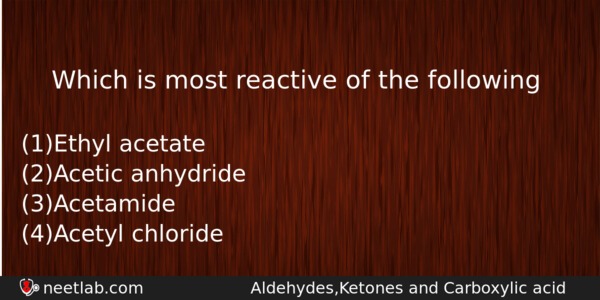
Which is most reactive of the following
Options
(a) Ethyl acetate
(b) Acetic anhydride
(c) Acetamide
(d) Acetyl chloride
Correct Answer:
Acetyl chloride
Explanation:
The order of reactivity of acid derivatives toward different reactions decreases in the order: RCOCl > (RCO₂)O > RCOOR’ > RCONH₂. In other words, the reactivity decreases as the basicity of the leaving group increases i.e. Cl⁻ < RCOO⁻ < RO⁻ < NH₂⁻.
Related Questions: - The reagent with which both acetaldehyde and acetone react easily is
- Nitrobenzene gives N-phenylhydroxylamine by
- Which of the following statement is true for an electrochemical cell
- Green chemistry means such reaction which
- When 22.4 litres of H₂(g) is mixed with 11.2 litres of Cl₂(g) each at S.T.P,
Topics: Aldehydes Ketones and Carboxylic Acid
(89)
Subject: Chemistry
(2512)
Important MCQs Based on Medical Entrance Examinations To Improve Your NEET Score
- The reagent with which both acetaldehyde and acetone react easily is
- Nitrobenzene gives N-phenylhydroxylamine by
- Which of the following statement is true for an electrochemical cell
- Green chemistry means such reaction which
- When 22.4 litres of H₂(g) is mixed with 11.2 litres of Cl₂(g) each at S.T.P,
Topics: Aldehydes Ketones and Carboxylic Acid (89)
Subject: Chemistry (2512)
Important MCQs Based on Medical Entrance Examinations To Improve Your NEET Score
18000+ students are using NEETLab to improve their score. What about you?
Solve Previous Year MCQs, Mock Tests, Topicwise Practice Tests, Identify Weak Topics, Formula Flash cards and much more is available in NEETLab Android App to improve your NEET score.

Share this page with your friends
Leave a Reply