| ⇦ | 
| ⇨ |
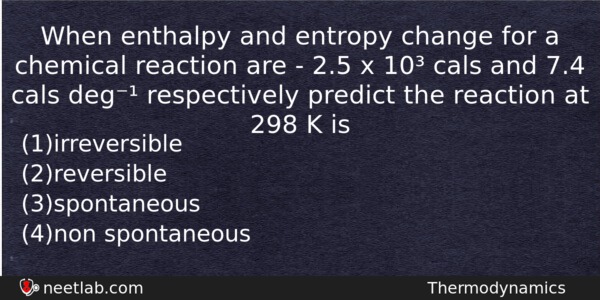
When enthalpy and entropy change for a chemical reaction are – 2.5 x 10³ cals and 7.4 cals deg⁻¹ respectively predict the reaction at 298 K is
Options
(a) irreversible
(b) reversible
(c) spontaneous
(d) non spontaneous
Correct Answer:
spontaneous
Explanation:
Enthalpy change, ∆H = -2.5 ⨯ 10³ cal
Entropy change, ∆G = 7.4 kcal deg⁻¹
Temperature, T = 298 K
As, ∆G = ∆H -T∆S
⇒ ∆G = -2.5 ⨯ 10³ – 298 ⨯ 7.4 = -ve value
For spontaneity of reaction, negative value of ∆G is required, so the reaction is spontaneous.
Related Questions: - A 2.5 mol sample of N₂H₄ loses 25 mol of electrons in being converted
- Which one of the following reagents will be able to distinguish between 1-butyne
- When chloroform is exposed to light and air, it forms
- An important product in the ozone depletion by chlorofluorocarbons is
- The amount of zinc required to produce 224mL of H₂ at STP on treatment with dilute H₂SO₄
Topics: Thermodynamics
(179)
Subject: Chemistry
(2512)
Important MCQs Based on Medical Entrance Examinations To Improve Your NEET Score
- A 2.5 mol sample of N₂H₄ loses 25 mol of electrons in being converted
- Which one of the following reagents will be able to distinguish between 1-butyne
- When chloroform is exposed to light and air, it forms
- An important product in the ozone depletion by chlorofluorocarbons is
- The amount of zinc required to produce 224mL of H₂ at STP on treatment with dilute H₂SO₄
Topics: Thermodynamics (179)
Subject: Chemistry (2512)
Important MCQs Based on Medical Entrance Examinations To Improve Your NEET Score
18000+ students are using NEETLab to improve their score. What about you?
Solve Previous Year MCQs, Mock Tests, Topicwise Practice Tests, Identify Weak Topics, Formula Flash cards and much more is available in NEETLab Android App to improve your NEET score.

Share this page with your friends
Leave a Reply