| ⇦ | 
| ⇨ |
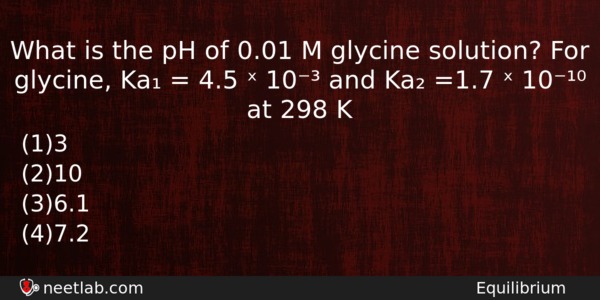
What is the pH of 0.01 M glycine solution? For glycine, Ka₁ = 4.5 ˣ 10⁻³ and Ka₂ =1.7 ˣ 10⁻¹⁰ at 298 K
Options
(a) 3
(b) 10
(c) 6.1
(d) 7.2
Correct Answer:
6.1
Explanation:
K = Kₐ₁ x Kₐ₂ = 4.5 x 10⁻³ * 1.7 x 10⁻¹⁰,
7.65 x 10⁻¹³,
[H⁺] = √KC = √7.65 x 10⁻¹³ x 0.01 ,
= √7.65 x 10⁻¹⁵
= 0.87 x 10⁻⁷. pH = -log 0.87 x 10⁻⁷
= 7 – 0.93 = 6.07.
Related Questions: - The most probable radius (in pm) for finding the electron in He⁺ is
- During the electrolysis of fused sodium chloride the anodic reaction is
- What is the formula of bleaching powder
- Which of the following is a chiral compound
- Which one of the following is a chain growth polymer
Topics: Equilibrium
(104)
Subject: Chemistry
(2512)
Important MCQs Based on Medical Entrance Examinations To Improve Your NEET Score
- The most probable radius (in pm) for finding the electron in He⁺ is
- During the electrolysis of fused sodium chloride the anodic reaction is
- What is the formula of bleaching powder
- Which of the following is a chiral compound
- Which one of the following is a chain growth polymer
Topics: Equilibrium (104)
Subject: Chemistry (2512)
Important MCQs Based on Medical Entrance Examinations To Improve Your NEET Score
18000+ students are using NEETLab to improve their score. What about you?
Solve Previous Year MCQs, Mock Tests, Topicwise Practice Tests, Identify Weak Topics, Formula Flash cards and much more is available in NEETLab Android App to improve your NEET score.

Share this page with your friends
Leave a Reply