| ⇦ | 
| ⇨ |
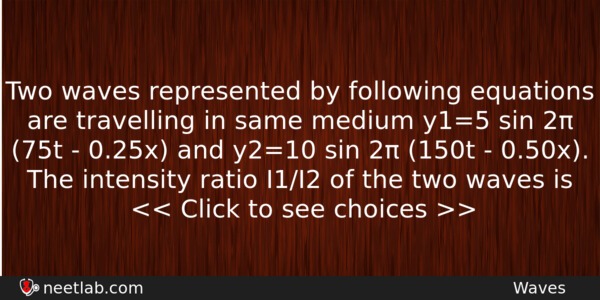
Two waves represented by following equations are travelling in same medium y1=5 sin 2π (75t – 0.25x) and y2=10 sin 2π (150t – 0.50x). The intensity ratio I1/I2 of the two waves is
Options
(a) 1 : 2
(b) 1 : 4
(c) 1 : 8
(d) 1 : 16
Correct Answer:
1 : 4
Explanation:
No explanation available. Be the first to write the explanation for this question by commenting below.
Related Questions: - If a small amount of antimony is added to germanium crystal
- If the angular momentum of any rotating body increase by 200 % , then the increase
- Maximum kinetic energy of electrons emitted in photoelectric effect increases when
- In Young’s double slit experiment, the phase difference between the two waves
- Source S₁ is producing, 10¹⁵ photons per second of wavelength 5000Å
Topics: Waves
(80)
Subject: Physics
(2479)
Important MCQs Based on Medical Entrance Examinations To Improve Your NEET Score
- If a small amount of antimony is added to germanium crystal
- If the angular momentum of any rotating body increase by 200 % , then the increase
- Maximum kinetic energy of electrons emitted in photoelectric effect increases when
- In Young’s double slit experiment, the phase difference between the two waves
- Source S₁ is producing, 10¹⁵ photons per second of wavelength 5000Å
Topics: Waves (80)
Subject: Physics (2479)
Important MCQs Based on Medical Entrance Examinations To Improve Your NEET Score
18000+ students are using NEETLab to improve their score. What about you?
Solve Previous Year MCQs, Mock Tests, Topicwise Practice Tests, Identify Weak Topics, Formula Flash cards and much more is available in NEETLab Android App to improve your NEET score.

Share this page with your friends
A1=5
A2=10
I is directly proportional to A^2
I1/I2=25/100
1:4
It is 1/16….here frequencies are also different…so put the total intensity formula