| ⇦ | 
| ⇨ |
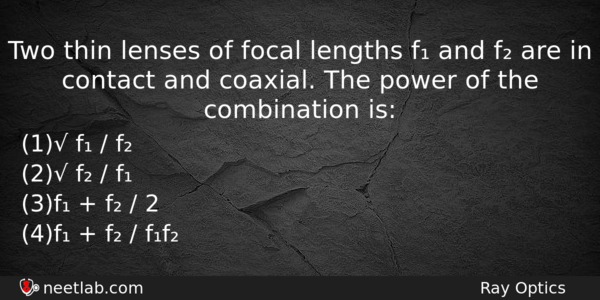
Two thin lenses of focal lengths f₁ and f₂ are in contact and coaxial. The power of the combination is:
Options
(a) √ f₁ / f₂
(b) √ f₂ / f₁
(c) f₁ + f₂ / 2
(d) f₁ + f₂ / f₁f₂
Correct Answer:
f₁ + f₂ / f₁f₂
Explanation:
The focal length of the combination
1/f = 1/f₁ + 1/f₂
Power of the combinations,
P = f₁ + f₂ / f₁ f₂ ( P = 1 / f )
Related Questions: - The bandgap in Germanium and silicon, in eV, are respectively
- A susceptibility of a certain magnetic material is 400. What is the class
- In a series resonant LCR circuit, the voltage across R is 100 volts and R =1kΩ
- If A=4i+4j+4k and b=3i+j+4k, then angle between vectors A and B is
- The total energy of a simple harmonic oscillator is proportional to
Topics: Ray Optics
(94)
Subject: Physics
(2479)
Important MCQs Based on Medical Entrance Examinations To Improve Your NEET Score
- The bandgap in Germanium and silicon, in eV, are respectively
- A susceptibility of a certain magnetic material is 400. What is the class
- In a series resonant LCR circuit, the voltage across R is 100 volts and R =1kΩ
- If A=4i+4j+4k and b=3i+j+4k, then angle between vectors A and B is
- The total energy of a simple harmonic oscillator is proportional to
Topics: Ray Optics (94)
Subject: Physics (2479)
Important MCQs Based on Medical Entrance Examinations To Improve Your NEET Score
18000+ students are using NEETLab to improve their score. What about you?
Solve Previous Year MCQs, Mock Tests, Topicwise Practice Tests, Identify Weak Topics, Formula Flash cards and much more is available in NEETLab Android App to improve your NEET score.

Share this page with your friends
Leave a Reply