| ⇦ | 
| ⇨ |
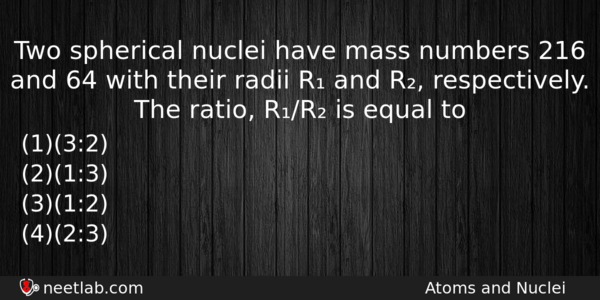
Two spherical nuclei have mass numbers 216 and 64 with their radii R₁ and R₂, respectively. The ratio, R₁/R₂ is equal to
Options
(a) (3:2)
(b) (1:3)
(c) (1:2)
(d) (2:3)
Correct Answer:
(3:2)
Explanation:
Radius of nuclei having mass number A is determined as
R = R₀ A¹/³ (where R₀ = constant)
where, R₀ = 1.2 x 10⁻¹⁵ m
This implies, R₁/R₂ = (A₁/A₂)¹/³ = (216/64)¹/³ = 6/4
R₁:R₂ = 3:2
Related Questions: - The wavelength of the matter wave is independent of
- The physical quantities not having same dimensions are
- The resistance in the two arms of the meter bridge are 5Ω and RΩ, respectively
- A particle moves in a circle of radius 5 cm with constant speed and time period
- A 1Ω resistance in series with an ammeter is balanced by 75 cm of potentiometer wire
Topics: Atoms and Nuclei
(136)
Subject: Physics
(2479)
Important MCQs Based on Medical Entrance Examinations To Improve Your NEET Score
- The wavelength of the matter wave is independent of
- The physical quantities not having same dimensions are
- The resistance in the two arms of the meter bridge are 5Ω and RΩ, respectively
- A particle moves in a circle of radius 5 cm with constant speed and time period
- A 1Ω resistance in series with an ammeter is balanced by 75 cm of potentiometer wire
Topics: Atoms and Nuclei (136)
Subject: Physics (2479)
Important MCQs Based on Medical Entrance Examinations To Improve Your NEET Score
18000+ students are using NEETLab to improve their score. What about you?
Solve Previous Year MCQs, Mock Tests, Topicwise Practice Tests, Identify Weak Topics, Formula Flash cards and much more is available in NEETLab Android App to improve your NEET score.

Share this page with your friends
R=R°A^1/3. (R°=constant
R1÷R2 =(A1÷A2)^1/3
=(216÷64)^1/3
=6÷4.
=> R1:R2 = 3:2