| ⇦ | 
| ⇨ |
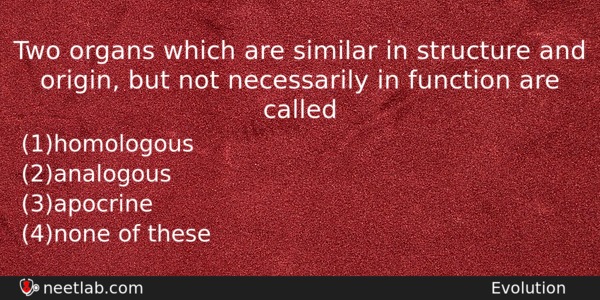
Two organs which are similar in structure and origin, but not necessarily in function are called
Options
(a) homologous
(b) analogous
(c) apocrine
(d) none of these
Correct Answer:
homologous
Explanation:
No explanation available. Be the first to write the explanation for this question by commenting below.
Related Questions: - What are those structures that appear as beads-on-string in the chromosomes
- Cessation of menstrual cycle in a woman is called?
- Pick up the wrong statement
- Enzyme that changes glucose to ethyl alcohol is
- Some of the enzymes which are associated in converting fats into carbohydrates
Topics: Evolution
(132)
Subject: Biology
(4253)
Important MCQs Based on Medical Entrance Examinations To Improve Your NEET Score
- What are those structures that appear as beads-on-string in the chromosomes
- Cessation of menstrual cycle in a woman is called?
- Pick up the wrong statement
- Enzyme that changes glucose to ethyl alcohol is
- Some of the enzymes which are associated in converting fats into carbohydrates
Topics: Evolution (132)
Subject: Biology (4253)
Important MCQs Based on Medical Entrance Examinations To Improve Your NEET Score
18000+ students are using NEETLab to improve their score. What about you?
Solve Previous Year MCQs, Mock Tests, Topicwise Practice Tests, Identify Weak Topics, Formula Flash cards and much more is available in NEETLab Android App to improve your NEET score.

Share this page with your friends
Leave a Reply