| ⇦ | 
| ⇨ |
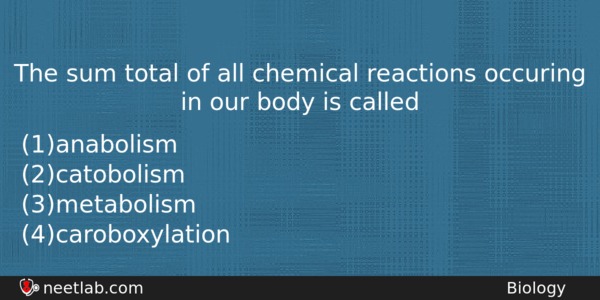
The sum total of all chemical reactions occuring in our body is called
Options
(a) anabolism
(b) catobolism
(c) metabolism
(d) caroboxylation
Correct Answer:
metabolism
Explanation:
No explanation available. Be the first to write the explanation for this question by commenting below.
Related Questions: - Which one of the following organisms is not an example of eukaryotic cells?
- Select the correct statement about drugs from the ones given below?
- For its activity, carboxypertidase requires
- A vascular bundle having phloem on either side of the xylem
- A competitive inhibitor of succinic dehydrogenase is
Question Type: Memory
(964)
Difficulty Level: Easy
(1008)
Topics: Diversity In Living World
(339)
Subject: Biology
(4253)
Important MCQs Based on Medical Entrance Examinations To Improve Your NEET Score
- Which one of the following organisms is not an example of eukaryotic cells?
- Select the correct statement about drugs from the ones given below?
- For its activity, carboxypertidase requires
- A vascular bundle having phloem on either side of the xylem
- A competitive inhibitor of succinic dehydrogenase is
Question Type: Memory (964)
Difficulty Level: Easy (1008)
Topics: Diversity In Living World (339)
Subject: Biology (4253)
Important MCQs Based on Medical Entrance Examinations To Improve Your NEET Score
18000+ students are using NEETLab to improve their score. What about you?
Solve Previous Year MCQs, Mock Tests, Topicwise Practice Tests, Identify Weak Topics, Formula Flash cards and much more is available in NEETLab Android App to improve your NEET score.

Share this page with your friends
As,the Metabolism is the sum of the chemical reactions that take place within each cell of a living organism and that provide energy for vital processes and for synthesizing new organic material,Therefore The sum total of all chemical reactions occuring in our body is called metabolism.