| ⇦ | 
| ⇨ |
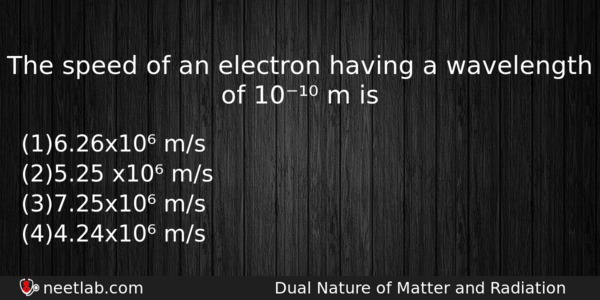
The speed of an electron having a wavelength of 10⁻¹⁰ m is
Options
(a) 6.26×10⁶ m/s
(b) 5.25 x10⁶ m/s
(c) 7.25×10⁶ m/s
(d) 4.24×10⁶ m/s
Correct Answer:
7.25×10⁶ m/s
Explanation:
λ = h / momentum = h / mv
v = h / mλ = 6.6 × 10⁻³⁴ / (9 × 10⁻³¹) × 10⁻¹°
v = 7.25 × 10⁶ ms⁻¹
Related Questions: - 1 curie is equal to
- Which of the following atoms has the lowest ionisation potential?
- If two slits in Young’s experiment are 0.4 mm apart and fringe width on a screen
- Huygen’s wave theory could not explain
- A force of 10 newton acts on a body of mass 20 kg for 10 seconds. Change in its momentum
Topics: Dual Nature of Matter and Radiation
(150)
Subject: Physics
(2479)
Important MCQs Based on Medical Entrance Examinations To Improve Your NEET Score
- 1 curie is equal to
- Which of the following atoms has the lowest ionisation potential?
- If two slits in Young’s experiment are 0.4 mm apart and fringe width on a screen
- Huygen’s wave theory could not explain
- A force of 10 newton acts on a body of mass 20 kg for 10 seconds. Change in its momentum
Topics: Dual Nature of Matter and Radiation (150)
Subject: Physics (2479)
Important MCQs Based on Medical Entrance Examinations To Improve Your NEET Score
18000+ students are using NEETLab to improve their score. What about you?
Solve Previous Year MCQs, Mock Tests, Topicwise Practice Tests, Identify Weak Topics, Formula Flash cards and much more is available in NEETLab Android App to improve your NEET score.

Share this page with your friends
P=h/lamba…..1equ
P= momentum
H=Planck’s constant
Lamba= wavelength
And
P=MV…..2 equ
M= mass
V= speed
Put 2 in 1
MV=h/lamba
9.1×10^-31*v=6.6×10^-34/10^-10
By solving u get the value of v
V=0.725*10^7=7.25*10^6