| ⇦ | 
| ⇨ |
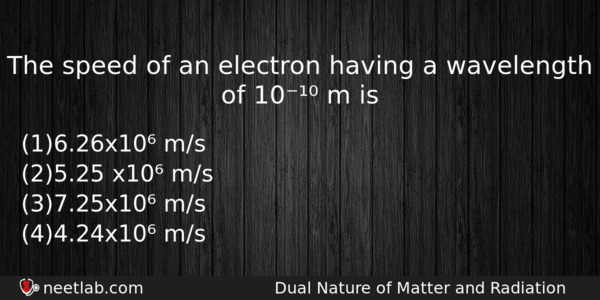
The speed of an electron having a wavelength of 10⁻¹⁰ m is
Options
(a) 6.26×10⁶ m/s
(b) 5.25 x10⁶ m/s
(c) 7.25×10⁶ m/s
(d) 4.24×10⁶ m/s
Correct Answer:
7.25×10⁶ m/s
Explanation:
λ = h / momentum = h / mv
v = h / mλ = 6.6 × 10⁻³⁴ / (9 × 10⁻³¹) × 10⁻¹°
v = 7.25 × 10⁶ ms⁻¹
Related Questions: - A particle performing uniform circular motion has angular momentum
- The velocity of a particle performing simple harmonic motion, when it passes
- The atomic number of the most common element in nuclear fusion is
- In the diffraction pattern of a single slit
- Power dissipated in an LCR series circuit connected to an a.c source of emf ? is
Topics: Dual Nature of Matter and Radiation
(150)
Subject: Physics
(2479)
Important MCQs Based on Medical Entrance Examinations To Improve Your NEET Score
- A particle performing uniform circular motion has angular momentum
- The velocity of a particle performing simple harmonic motion, when it passes
- The atomic number of the most common element in nuclear fusion is
- In the diffraction pattern of a single slit
- Power dissipated in an LCR series circuit connected to an a.c source of emf ? is
Topics: Dual Nature of Matter and Radiation (150)
Subject: Physics (2479)
Important MCQs Based on Medical Entrance Examinations To Improve Your NEET Score
18000+ students are using NEETLab to improve their score. What about you?
Solve Previous Year MCQs, Mock Tests, Topicwise Practice Tests, Identify Weak Topics, Formula Flash cards and much more is available in NEETLab Android App to improve your NEET score.

Share this page with your friends
P=h/lamba…..1equ
P= momentum
H=Planck’s constant
Lamba= wavelength
And
P=MV…..2 equ
M= mass
V= speed
Put 2 in 1
MV=h/lamba
9.1×10^-31*v=6.6×10^-34/10^-10
By solving u get the value of v
V=0.725*10^7=7.25*10^6