| ⇦ | 
| ⇨ |
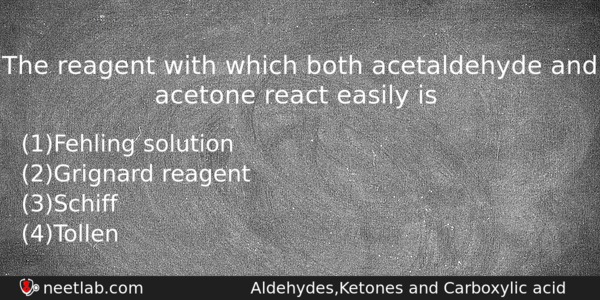
The reagent with which both acetaldehyde and acetone react easily is
Options
(a) Fehling solution
(b) Grignard reagent
(c) Schiff’s reagent
(d) Tollen’s reagent
Correct Answer:
Grignard reagent
Explanation:
No explanation available. Be the first to write the explanation for this question by commenting below.
Related Questions: - This radical can be identified by Borax bead test is
- A trend common to both for group I and VII elements in the periodic table
- The covalent bond length is the shortest in which one of the following bonds
- Certain bimolecular reactions which following first order kinetics are called
- Which one of the following statements is not true
Topics: Aldehydes Ketones and Carboxylic Acid
(89)
Subject: Chemistry
(2512)
Important MCQs Based on Medical Entrance Examinations To Improve Your NEET Score
- This radical can be identified by Borax bead test is
- A trend common to both for group I and VII elements in the periodic table
- The covalent bond length is the shortest in which one of the following bonds
- Certain bimolecular reactions which following first order kinetics are called
- Which one of the following statements is not true
Topics: Aldehydes Ketones and Carboxylic Acid (89)
Subject: Chemistry (2512)
Important MCQs Based on Medical Entrance Examinations To Improve Your NEET Score
18000+ students are using NEETLab to improve their score. What about you?
Solve Previous Year MCQs, Mock Tests, Topicwise Practice Tests, Identify Weak Topics, Formula Flash cards and much more is available in NEETLab Android App to improve your NEET score.

Share this page with your friends
Because the other three reagents reacts only with aldehydes