| ⇦ | 
| ⇨ |
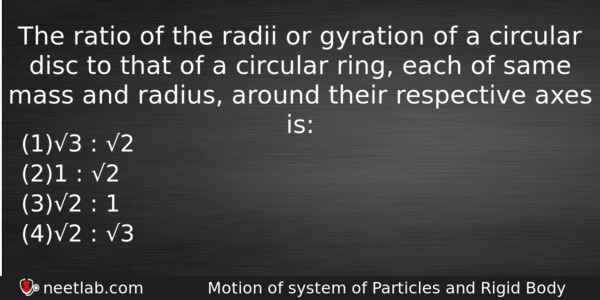
The ratio of the radii or gyration of a circular disc to that of a circular ring, each of same mass and radius, around their respective axes is:
Options
(a) √3 : √2
(b) 1 : √2
(c) √2 : 1
(d) √2 : √3
Correct Answer:
1 : √2
Explanation:
The radius of gyration of a ociruclar ring K’ = R (Since both have the same mass and radius)
K / K’ = R / (√2 / R) = 1 / √2
Related Questions: - The heat dissipated in a resistance can be obtained by measuring of resistance,
- Radioactivity of a sample at T₁ time is R₁ and at time T₂ is R₂. If half-life
- Four point masses, each of value m, are placed at the corners of a square ABCD
- A particle of mass m, charge Q and kinetic enery T enters a transverse
- A electric dipole is placed at an angle of 30⁰ to a non-uniform electric field.
Topics: Motion of system of Particles and Rigid Body
(73)
Subject: Physics
(2479)
Important MCQs Based on Medical Entrance Examinations To Improve Your NEET Score
- The heat dissipated in a resistance can be obtained by measuring of resistance,
- Radioactivity of a sample at T₁ time is R₁ and at time T₂ is R₂. If half-life
- Four point masses, each of value m, are placed at the corners of a square ABCD
- A particle of mass m, charge Q and kinetic enery T enters a transverse
- A electric dipole is placed at an angle of 30⁰ to a non-uniform electric field.
Topics: Motion of system of Particles and Rigid Body (73)
Subject: Physics (2479)
Important MCQs Based on Medical Entrance Examinations To Improve Your NEET Score
18000+ students are using NEETLab to improve their score. What about you?
Solve Previous Year MCQs, Mock Tests, Topicwise Practice Tests, Identify Weak Topics, Formula Flash cards and much more is available in NEETLab Android App to improve your NEET score.

Share this page with your friends
Leave a Reply