| ⇦ | 
| ⇨ |
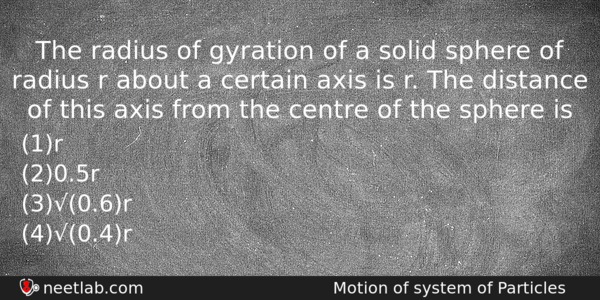
The radius of gyration of a solid sphere of radius r about a certain axis is r. The distance of this axis from the centre of the sphere is
Options
(a) r
(b) 0.5r
(c) √(0.6)r
(d) √(0.4)r
Correct Answer:
√(0.6)r
Explanation:
No explanation available. Be the first to write the explanation for this question by commenting below.
Related Questions: - A radio isotope X with a half life 1.4 x 10⁹ years decays to Y which is stable
- If ∆Q>0 when heat flows into a system, ∆W>0 when work is done on the system
- The electrons are emitted in the photoelectric effect from a metal surface
- Two identical capacitors are first connected in series and then in parallel.
- The value of workdone for rotating a magnet of magnetic moment M by an angle θ in external
Topics: Motion of system of Particles and Rigid Body
(73)
Subject: Physics
(2479)
Important MCQs Based on Medical Entrance Examinations To Improve Your NEET Score
- A radio isotope X with a half life 1.4 x 10⁹ years decays to Y which is stable
- If ∆Q>0 when heat flows into a system, ∆W>0 when work is done on the system
- The electrons are emitted in the photoelectric effect from a metal surface
- Two identical capacitors are first connected in series and then in parallel.
- The value of workdone for rotating a magnet of magnetic moment M by an angle θ in external
Topics: Motion of system of Particles and Rigid Body (73)
Subject: Physics (2479)
Important MCQs Based on Medical Entrance Examinations To Improve Your NEET Score
18000+ students are using NEETLab to improve their score. What about you?
Solve Previous Year MCQs, Mock Tests, Topicwise Practice Tests, Identify Weak Topics, Formula Flash cards and much more is available in NEETLab Android App to improve your NEET score.

Share this page with your friends
Using parallel axis theorem ,
I =Icm(about the centre of mass) + M(mass of the sphere)h2. where h is the required distance of the axis from centre of sphere
MK2 = 2/5 MR2. + Mh2
K2= 2R2/5 + h2
R2 = 2R2/5. + h2. (given that. K=R. )
3R2/5 = h2
Which gives h=√3/5R2
h=√0.6. R. (Answer)