| ⇦ | 
| ⇨ |
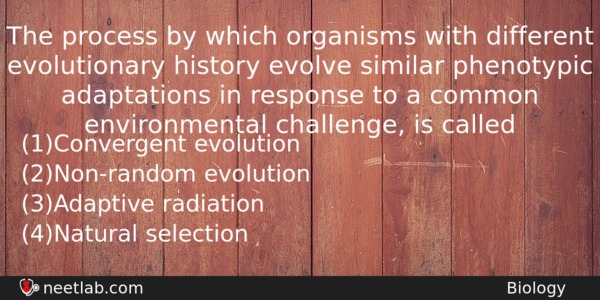
The process by which organisms with different evolutionary history evolve similar phenotypic adaptations in response to a common environmental challenge, is called
Options
(a) Convergent evolution
(b) Non-random evolution
(c) Adaptive radiation
(d) Natural selection
Correct Answer:
Convergent evolution
Explanation:
No explanation available. Be the first to write the explanation for this question by commenting below.
Related Questions: - In a cymose inflorescence the main axis
- The energy-releasing process in which the substrate is oxidised without an external
- The long neck of camel is due to
- Pentamerous, actinomorphic flowers, bicarpellate ovary with oblique septa and fruit
- Excretory system of Ascaris lumbricoides is made up of
Question Type: Memory
(964)
Difficulty Level: Easy
(1008)
Topics: Evolution
(132)
Subject: Biology
(4253)
Important MCQs Based on Medical Entrance Examinations To Improve Your NEET Score
- In a cymose inflorescence the main axis
- The energy-releasing process in which the substrate is oxidised without an external
- The long neck of camel is due to
- Pentamerous, actinomorphic flowers, bicarpellate ovary with oblique septa and fruit
- Excretory system of Ascaris lumbricoides is made up of
Question Type: Memory (964)
Difficulty Level: Easy (1008)
Topics: Evolution (132)
Subject: Biology (4253)
Important MCQs Based on Medical Entrance Examinations To Improve Your NEET Score
18000+ students are using NEETLab to improve their score. What about you?
Solve Previous Year MCQs, Mock Tests, Topicwise Practice Tests, Identify Weak Topics, Formula Flash cards and much more is available in NEETLab Android App to improve your NEET score.

Share this page with your friends
Leave a Reply