| ⇦ | 
| ⇨ |
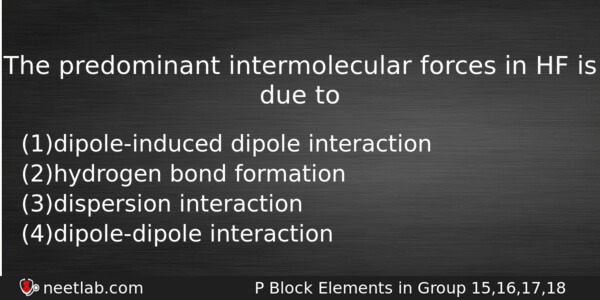
The predominant intermolecular forces in HF is due to
Options
(a) dipole-induced dipole interaction
(b) hydrogen bond formation
(c) dispersion interaction
(d) dipole-dipole interaction
Correct Answer:
hydrogen bond formation
Explanation:
In intermolecular hydrogen bonding two or more than two molecules of the same compounds combine together to give a polymeric aggregate.
Related Questions: - Which of the following statements about amorphous solids is incorrect
- The reactive species in the nitration of benzene is
- Which is the correct order of increasing energy of the listed orbitals in the atom
- In an exothermic reaction(reversible) which of the following has positive value
- Serotonin is usually used as
Topics: P Block Elements in Group 15
(89)
Subject: Chemistry
(2512)
Important MCQs Based on Medical Entrance Examinations To Improve Your NEET Score
- Which of the following statements about amorphous solids is incorrect
- The reactive species in the nitration of benzene is
- Which is the correct order of increasing energy of the listed orbitals in the atom
- In an exothermic reaction(reversible) which of the following has positive value
- Serotonin is usually used as
Topics: P Block Elements in Group 15 (89)
Subject: Chemistry (2512)
Important MCQs Based on Medical Entrance Examinations To Improve Your NEET Score
18000+ students are using NEETLab to improve their score. What about you?
Solve Previous Year MCQs, Mock Tests, Topicwise Practice Tests, Identify Weak Topics, Formula Flash cards and much more is available in NEETLab Android App to improve your NEET score.

Share this page with your friends
Leave a Reply