| ⇦ | 
| ⇨ |
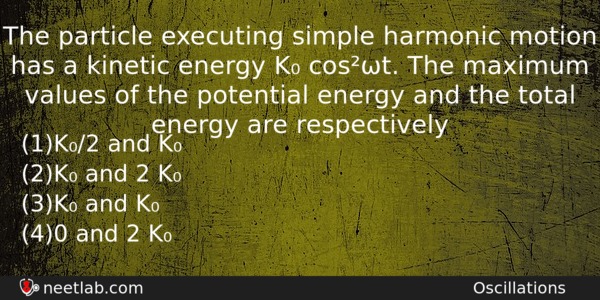
The particle executing simple harmonic motion has a kinetic energy K₀ cos²ωt. The maximum values of the potential energy and the total energy are respectively
Options
(a) K₀/2 and K₀
(b) K₀ and 2 K₀
(c) K₀ and K₀
(d) 0 and 2 K₀
Correct Answer:
K₀ and K₀
Explanation:
Kinetic energy + Potential energy = total energy
When kinetic energy is maximum, potential energy is zero and vice versa.
.·. Maximum potential energy = total energy
0 + K₀ = K₀
(K.E + P.E = Total energy) .
Related Questions: - In a vaccum triode the function of grid voltage is
- In Wheatstone bridge, three resistors P,Q and R are conncected in three arms
- Water flows through a pipe. The area of cross-section at one place A₁=10 cm²,
- A uniform chain of length L and mass m is kept on a smooth table. It is released
- A thin circular ring of mass M and radius R is rotating in a horizontal plane about
Topics: Oscillations
(58)
Subject: Physics
(2479)
Important MCQs Based on Medical Entrance Examinations To Improve Your NEET Score
- In a vaccum triode the function of grid voltage is
- In Wheatstone bridge, three resistors P,Q and R are conncected in three arms
- Water flows through a pipe. The area of cross-section at one place A₁=10 cm²,
- A uniform chain of length L and mass m is kept on a smooth table. It is released
- A thin circular ring of mass M and radius R is rotating in a horizontal plane about
Topics: Oscillations (58)
Subject: Physics (2479)
Important MCQs Based on Medical Entrance Examinations To Improve Your NEET Score
18000+ students are using NEETLab to improve their score. What about you?
Solve Previous Year MCQs, Mock Tests, Topicwise Practice Tests, Identify Weak Topics, Formula Flash cards and much more is available in NEETLab Android App to improve your NEET score.

Share this page with your friends
Leave a Reply