| ⇦ | 
| ⇨ |
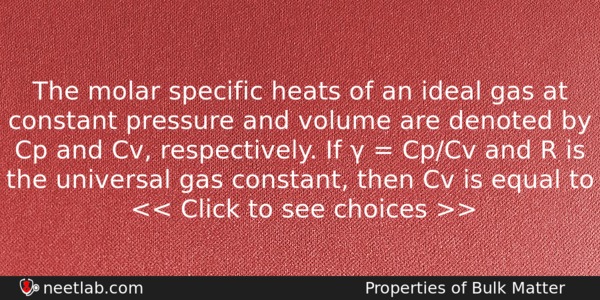
The molar specific heats of an ideal gas at constant pressure and volume are denoted by Cp and Cv, respectively. If γ = Cp/Cv and R is the universal gas constant, then Cv is equal to
Options
(a) R / ( γ – 1)
(b) (γ – 1) / R
(c) γ R
(d) 1 + γ / 1 – γ
Correct Answer:
R / ( γ – 1)
Explanation:
Cₚ – Cᵥ = R ⇒ Cₚ = Cᵥ + R
γ = Cₚ / Cᵥ = Cᵥ + R / Cᵥ = Cᵥ / Cᵥ + R / Cᵥ
⇒ γ = 1 + R / Cᵥ ⇒ R / Cᵥ = γ – 1
⇒ Cᵥ = R / γ – 1
Related Questions: - Which one of the following is not due to total internal reflection?
- A 1m long wire of diameter 0.31 mm has a resistance of 4.2Ω. If it is replaced by
- If a magnetic substance is kept in a magnetic field, then which of the following
- At what height h above earth, the value of g becomes g/2 (where R=radius of earth)?
- If the ratio of amplitude of two superposed waves is 2:1, then the ratio of maximum
Topics: Properties of Bulk Matter
(130)
Subject: Physics
(2479)
Important MCQs Based on Medical Entrance Examinations To Improve Your NEET Score
- Which one of the following is not due to total internal reflection?
- A 1m long wire of diameter 0.31 mm has a resistance of 4.2Ω. If it is replaced by
- If a magnetic substance is kept in a magnetic field, then which of the following
- At what height h above earth, the value of g becomes g/2 (where R=radius of earth)?
- If the ratio of amplitude of two superposed waves is 2:1, then the ratio of maximum
Topics: Properties of Bulk Matter (130)
Subject: Physics (2479)
Important MCQs Based on Medical Entrance Examinations To Improve Your NEET Score
18000+ students are using NEETLab to improve their score. What about you?
Solve Previous Year MCQs, Mock Tests, Topicwise Practice Tests, Identify Weak Topics, Formula Flash cards and much more is available in NEETLab Android App to improve your NEET score.

Share this page with your friends
Leave a Reply