| ⇦ | 
| ⇨ |
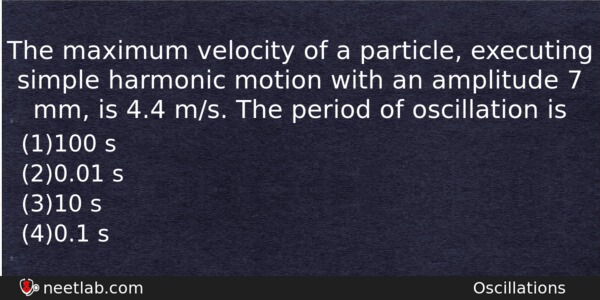
The maximum velocity of a particle, executing simple harmonic motion with an amplitude 7 mm, is 4.4 m/s. The period of oscillation is
Options
(a) 100 s
(b) 0.01 s
(c) 10 s
(d) 0.1 s
Correct Answer:
0.01 s
Explanation:
No explanation available. Be the first to write the explanation for this question by commenting below.
Related Questions: - Water rises to a height h in a capillary at the surface of earth. On the surface
- The dimensions of Planck’s constant is same as that of
- A body of length 1 m having cross-sectional area 0.75 m² has heat flow through it
- An electric bulb has a rated power of 50W at 100 V. if it used on an a.c. source
- If alternating source of primary coil on transformer is replaced by a Laclanche cell
Topics: Oscillations
(58)
Subject: Physics
(2479)
Important MCQs Based on Medical Entrance Examinations To Improve Your NEET Score
- Water rises to a height h in a capillary at the surface of earth. On the surface
- The dimensions of Planck’s constant is same as that of
- A body of length 1 m having cross-sectional area 0.75 m² has heat flow through it
- An electric bulb has a rated power of 50W at 100 V. if it used on an a.c. source
- If alternating source of primary coil on transformer is replaced by a Laclanche cell
Topics: Oscillations (58)
Subject: Physics (2479)
Important MCQs Based on Medical Entrance Examinations To Improve Your NEET Score
18000+ students are using NEETLab to improve their score. What about you?
Solve Previous Year MCQs, Mock Tests, Topicwise Practice Tests, Identify Weak Topics, Formula Flash cards and much more is available in NEETLab Android App to improve your NEET score.

Share this page with your friends
Leave a Reply