| ⇦ | 
| ⇨ |
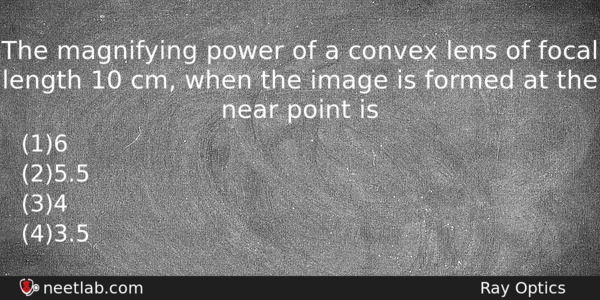
The magnifying power of a convex lens of focal length 10 cm, when the image is formed at the near point is
Options
(a) 6
(b) 5.5
(c) 4
(d) 3.5
Correct Answer:
3.5
Explanation:
No explanation available. Be the first to write the explanation for this question by commenting below.
Related Questions: - Energy stored in the coil of a self inductance 40 mH carrying a steady current of 2A
- The ratio of the nuclear radii of elements with mass numbers 216 and 125 is
- If radius of the ₁₃Al²⁷ nucleus is taken to be Rᴀı, then the radius of ₅₃Te¹²⁵ nucleus
- The device can act as a complete electronic circuit is
- If oxygen has root mean square velocity of C m/s, then root mean square velocity of H
Topics: Ray Optics
(94)
Subject: Physics
(2479)
Important MCQs Based on Medical Entrance Examinations To Improve Your NEET Score
- Energy stored in the coil of a self inductance 40 mH carrying a steady current of 2A
- The ratio of the nuclear radii of elements with mass numbers 216 and 125 is
- If radius of the ₁₃Al²⁷ nucleus is taken to be Rᴀı, then the radius of ₅₃Te¹²⁵ nucleus
- The device can act as a complete electronic circuit is
- If oxygen has root mean square velocity of C m/s, then root mean square velocity of H
Topics: Ray Optics (94)
Subject: Physics (2479)
Important MCQs Based on Medical Entrance Examinations To Improve Your NEET Score
18000+ students are using NEETLab to improve their score. What about you?
Solve Previous Year MCQs, Mock Tests, Topicwise Practice Tests, Identify Weak Topics, Formula Flash cards and much more is available in NEETLab Android App to improve your NEET score.

Share this page with your friends
explanation plzzz
M=1+d/f
We know that d is always 25 cm so by putting values you can get the answer…. thank you