| ⇦ | 
| ⇨ |
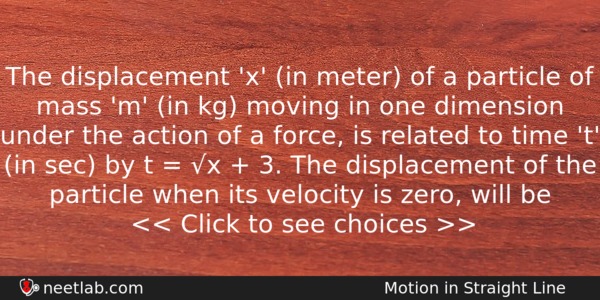
The displacement ‘x’ (in meter) of a particle of mass ‘m’ (in kg) moving in one dimension under the action of a force, is related to time ‘t’ (in sec) by t = √x + 3. The displacement of the particle when its velocity is zero, will be
Options
(a) 2 m
(b) 4 m
(c) zero
(d) 6 m
Correct Answer:
zero
Explanation:
t = √x + 3
⇒ √x = t – 3 ⇒ x = (t – 3)²
v = dx/ dt = 2 (t – 3) = 0 ⇒ t = 3
x = (3 – 3)² ⇒ x = 0.
Related Questions: - A fluid is in streamline flow across a horizontal pipe of variable area of cross section
- Two sound waves of wavelengths 5m and 6m formed 30 beats in 3 seconds
- A spring of spring constant 5 x 10³ N/m is stretched initially by 5 cm
- The quantity having the same units in all systems of unit is
- A potentiometer circuit has been set up for finding the internal resistance of a given
Topics: Motion in Straight Line
(93)
Subject: Physics
(2479)
Important MCQs Based on Medical Entrance Examinations To Improve Your NEET Score
- A fluid is in streamline flow across a horizontal pipe of variable area of cross section
- Two sound waves of wavelengths 5m and 6m formed 30 beats in 3 seconds
- A spring of spring constant 5 x 10³ N/m is stretched initially by 5 cm
- The quantity having the same units in all systems of unit is
- A potentiometer circuit has been set up for finding the internal resistance of a given
Topics: Motion in Straight Line (93)
Subject: Physics (2479)
Important MCQs Based on Medical Entrance Examinations To Improve Your NEET Score
18000+ students are using NEETLab to improve their score. What about you?
Solve Previous Year MCQs, Mock Tests, Topicwise Practice Tests, Identify Weak Topics, Formula Flash cards and much more is available in NEETLab Android App to improve your NEET score.

Share this page with your friends
Leave a Reply