| ⇦ | 
| ⇨ |
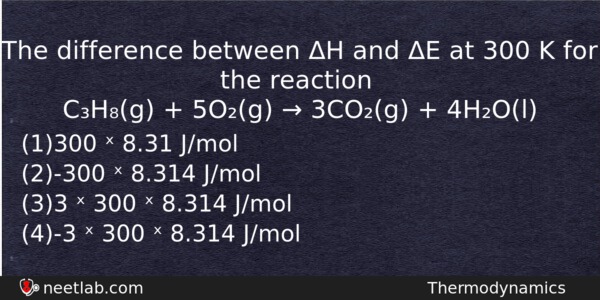
The difference between ΔH and ΔE at 300 K for the reaction
C₃H₈(g) + 5O₂(g) → 3CO₂(g) + 4H₂O(l)
Options
(a) 300 ˣ 8.31 J/mol
(b) -300 ˣ 8.314 J/mol
(c) 3 ˣ 300 ˣ 8.314 J/mol
(d) -3 ˣ 300 ˣ 8.314 J/mol
Correct Answer:
-3 ˣ 300 ˣ 8.314 J/mol
Explanation:
ΔH = ΔE + Δn(g)RT
or ΔH – ΔE = Δn(g)RT,
where Δn(g) = (3) – (5 + 1) = -3.
Thus, ΔH – ΔE = -3 * 8.31 *300 J/mol.
Related Questions: - An organic compound contains 40%C, 6.66% H and rest oxygen .its vapour density
- The structure of XeOF₄ is
- In acidic medium, H₂O₂ changes Cr₂O₇²⁻ to CrO₅ which has two
- Arsenic containing medicine used for the treatment of syphilis, is
- The oxidation state of Cr in K₂Cr₂O₇ is
Topics: Thermodynamics
(179)
Subject: Chemistry
(2512)
Important MCQs Based on Medical Entrance Examinations To Improve Your NEET Score
- An organic compound contains 40%C, 6.66% H and rest oxygen .its vapour density
- The structure of XeOF₄ is
- In acidic medium, H₂O₂ changes Cr₂O₇²⁻ to CrO₅ which has two
- Arsenic containing medicine used for the treatment of syphilis, is
- The oxidation state of Cr in K₂Cr₂O₇ is
Topics: Thermodynamics (179)
Subject: Chemistry (2512)
Important MCQs Based on Medical Entrance Examinations To Improve Your NEET Score
18000+ students are using NEETLab to improve their score. What about you?
Solve Previous Year MCQs, Mock Tests, Topicwise Practice Tests, Identify Weak Topics, Formula Flash cards and much more is available in NEETLab Android App to improve your NEET score.

Share this page with your friends
Leave a Reply