| ⇦ | 
| ⇨ |
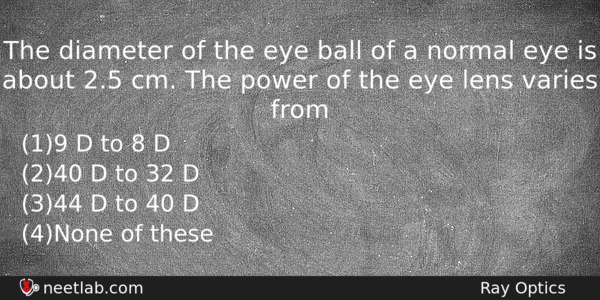
The diameter of the eye ball of a normal eye is about 2.5 cm. The power of the eye lens varies from
Options
(a) 9 D to 8 D
(b) 40 D to 32 D
(c) 44 D to 40 D
(d) None of these
Correct Answer:
44 D to 40 D
Explanation:
An eye see distant objects with full relaxation.
So, [1 / (2.5 × 10⁻²)] – [1 / -∞] = 1 / f or, P = 1 / f = 1 / 2.5 × 10⁻² = 40 D
An eye see an object at 25 cm with strain [1 / (2.5 × 10⁻²)] – [1 / 2.5 × 10⁻²] = 1 / f
.·. P = 1 / f = 40 + 4 = 44 D
Related Questions: - A light emitting diode(LED) has a voltage drop of 2 volt across it
- In Young’s double slit experiment, when wavelength used is 6000Å and the screen
- A disc of radius 0.1 m is rotating with a frequency 10 rev/sec in a normal magnetic
- The displacement of particle is given by x=aₒ+(a₁t/2)-(a₂t²/3) what is acceleration?
- A parallel plate capacitor as a uniform electric field E in the space between the plates
Topics: Ray Optics
(94)
Subject: Physics
(2479)
Important MCQs Based on Medical Entrance Examinations To Improve Your NEET Score
- A light emitting diode(LED) has a voltage drop of 2 volt across it
- In Young’s double slit experiment, when wavelength used is 6000Å and the screen
- A disc of radius 0.1 m is rotating with a frequency 10 rev/sec in a normal magnetic
- The displacement of particle is given by x=aₒ+(a₁t/2)-(a₂t²/3) what is acceleration?
- A parallel plate capacitor as a uniform electric field E in the space between the plates
Topics: Ray Optics (94)
Subject: Physics (2479)
Important MCQs Based on Medical Entrance Examinations To Improve Your NEET Score
18000+ students are using NEETLab to improve their score. What about you?
Solve Previous Year MCQs, Mock Tests, Topicwise Practice Tests, Identify Weak Topics, Formula Flash cards and much more is available in NEETLab Android App to improve your NEET score.

Share this page with your friends
Leave a Reply